
 Client area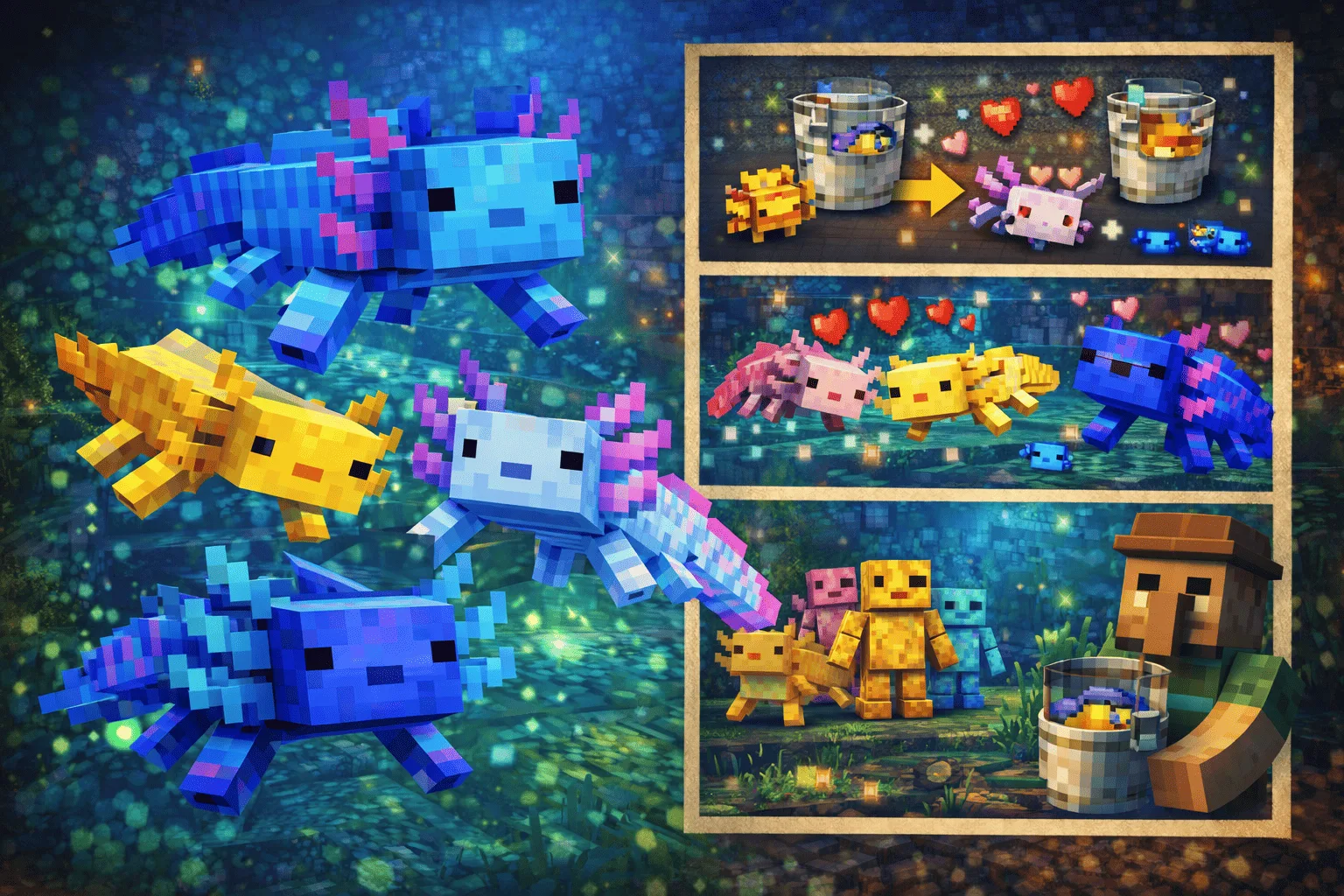
Axolotl Minecraft: Complete Guide (Finding, Taming, Variants)
The axolotl is one of the most popular mobs in Minecraft since its introduction in the 1.17 update (Caves & Cliffs: Part I). This aquatic amphibian, inspired by the critically endangered real-life species in Mexico, exists in five color variants in the game, including the most coveted rare Minecraft axolotl: the blue variant. Cute, useful in underwater combat, and collectible, the axolotl has become a must-have for players of all levels.
This guide covers everything you need to know about the Minecraft axolotl in 2026: where to find it, how to catch and tame it, what it eats, how to breed axolotls, and especially how to obtain the ultra-rare blue variant.
Where to Find Axolotls
Axolotls spawn exclusively in the lush caves biome. This underground biome, recognizable by its abundant vegetation (moss, azaleas, glow berries, clay), can generate at any altitude below the surface.
To locate a lush cave, the most reliable method is to look for azaleas on the surface. These flowering-leaved trees grow above lush caves. Dig directly under an azalea, and you will find the biome. Lush caves preferably generate under high-humidity biomes: dark forest, old taiga, bamboo jungle, birch forest. If you find one of these biomes near an ocean, the presence of a lush cave below is almost guaranteed.
The spawning conditions for axolotls are precise: they spawn in water inside a lush cave, provided a clay block is located within 5 blocks below the spawn space. The light level must be 0 (total darkness). They usually spawn in groups of 1 to 4 individuals.
To capture an axolotl, use a water bucket on it (right-click). You get a bucket of axolotl that you can carry in your inventory. This is the only method to move them over long distances. Be sure to bring at least two buckets if you want to bring back a pair for breeding.
What Do Axolotls Eat?
Axolotls eat only one food in Minecraft: the bucket of tropical fish. Note, this is not the raw tropical fish (the item), but the bucket containing a live tropical fish. This distinction is important because raw tropical fish does not trigger love mode or growth acceleration.
To obtain buckets of tropical fish, go to a warm or lukewarm ocean biome and use a water bucket on the tropical fish swimming there. Tropical fish also naturally spawn in lush caves and mangroves.
Buckets of tropical fish are not stackable (one per inventory slot), making mass breeding quite logistically challenging. For intensive breeding sessions, set up your breeding enclosure near a warm ocean to easily replenish your supplies.
Feeding an axolotl with a bucket of tropical fish restores 1 health point and triggers love mode if two adults are fed nearby. Feeding a baby axolotl accelerates its growth by 10% with each use.
How to Tame an Axolotl
Technically, axolotls cannot be tamed in the strict Minecraft sense (like a wolf or a cat). There is no taming mechanism that permanently binds them to the player. However, you can control them in several ways.
Firstly, axolotls follow any player holding a bucket of tropical fish in hand. This is the simplest way to guide them to an enclosure or aquarium. Secondly, you can leash them to prevent them from wandering away. Thirdly, by capturing them in a bucket and releasing them into a fenced pond at your home, you create a permanent enclosure.
Axolotls are valuable allies in underwater combat. They automatically attack fish, squids, glow squids, drowned, guardians, and elder guardians. When an allied axolotl kills a hostile mob (or when you kill a mob against which an axolotl was fighting), you receive the Regeneration I effect for 5 seconds per axolotl involved in the fight (up to 2 minutes of maximum regeneration). The Mining Fatigue effect inflicted by elder guardians is also removed.
In combat, axolotls have a unique survival behavior: when they take damage, they have a chance to play dead for a few seconds. During this phase, they are ignored by hostile mobs and regenerate health. This behavior is inspired by the real axolotl, known for its exceptional regenerative abilities.
For battles in ocean monuments (guardian raids), bring 5 to 10 axolotls in buckets and release them inside the monument. They will take care of the guardians while you explore, providing you with a constant flow of regeneration.
The Blue Axolotl: The Rarest Variant
The Minecraft blue axolotl is the most sought-after variant in the game. Unlike the other four colors, the blue axolotl (axolotl blue in English) cannot naturally spawn in lush caves. The only way to obtain it in survival mode is through breeding.
Spawn Probability
When breeding two axolotls (of any color), the baby has exactly a 1 in 1,200 (0.083%) chance of being blue. In the remaining 99.917% of cases, the baby inherits the color of one of its two parents, chosen randomly.
This 1/1200 ratio is not arbitrary. It refers to the estimated number of wild axolotls remaining in their natural habitat (Lake Xochimilco in Mexico), a nod from Mojang to raise player awareness of the species' critical situation in the real world.
In practice, obtaining a blue axolotl requires a considerable amount of breeding. Statistically, it takes an average of 1,200 attempts, but luck can be in your favor (or against you). Some players obtain it in less than 100 tries, while others exceed 2,000.
Once you have a first blue axolotl, breeding becomes easier. If you cross a blue axolotl with an axolotl of any other color, the baby has about a 50% chance of inheriting the blue (via the parental inheritance mechanism), plus the 0.083% blue mutation. Crossing two blue axolotls almost always results in a blue baby.
For impatient players, the command /summon minecraft:axolotl ~ ~ ~ {Variant:4} (Java Edition) allows you to directly summon a blue axolotl in creative mode or with cheats enabled. On Bedrock Edition, the command is /summon axolotl ~ ~ ~ minecraft:entity_born followed by a component event.
Breeding
To maximize your chances of obtaining the blue axolotl, set up a dedicated breeding farm. Here is the optimal method:
Build a shallow pool (1 to 2 blocks deep) with walls at least 2 blocks high to prevent axolotls from escaping. Set it up near a warm ocean for easy access to tropical fish. Start with at least 2 axolotls captured in a lush cave. Feed two adults with a bucket of tropical fish each to trigger love mode. A baby appears immediately.
The baby axolotl takes 20 minutes in real-time to become an adult. You can accelerate this growth by feeding it additional buckets of tropical fish (each feeding reduces the remaining time by 10%). Parents have a cooldown of 5 minutes (Java) or 1 minute (Bedrock) before they can breed again.
In intensive sessions, you can produce about 10 to 12 babies per hour with a single pair. With multiple pairs, the rate increases proportionally. The more adults you accumulate in your pool, the more attempts and chances you have to obtain the blue.
All Colors
Minecraft axolotls exist in five color variants. Four of them naturally spawn in lush caves with equal probability:
The leucistic (pale pink with dark pink gills) is the most iconic variant, often considered the "default color" of the Minecraft axolotl. The wild (brown) reproduces the most common color of axolotls in nature. The golden (yellow) offers a bright aspect highly appreciated for decoration. The cyan (light blue-green) is the only variant that visually resembles the blue variant but remains distinct.
The fifth variant, the blue (deep indigo), is exclusively obtained through breeding as detailed above. Visually, it is distinguished from cyan by a darker and more purplish hue.
All five variants have exactly the same statistics and behavior. The color is purely cosmetic and does not affect health points, damage, or combat behavior. The rarity of the blue axolotl is therefore entirely a matter of collection and prestige.
For collectors, an aquarium with all five variants is a classic in Minecraft bases. Use glass blocks, moss blocks, glow berries, and clay to recreate a lush cave environment in your base and provide an aesthetic habitat for your collection. To quickly identify each variant, observe the color of the gills and body: the leucistic has a light pink body with fuchsia gills, the wild is entirely dark brown, the golden is uniformly bright yellow, the cyan has a pastel blue-green, and the blue displays a strong indigo with distinctive purple spots.
Axolotl FAQ
Do axolotls despawn?
Axolotls captured in a bucket and then released never despawn. Natural axolotls (not captured) can despawn if the player moves too far away. To secure your axolotls, always capture them in a bucket before releasing them in your base, or name them with a tag.
Can the axolotl survive out of water?
An axolotl out of water takes drying damage after 5 minutes. It actively seeks to reach the nearest water. Under a block exposed to rain, the drying timer resets. Always provide a water path in your enclosures to prevent accidental losses.
How many health points does an axolotl have?
An axolotl has 14 health points (7 hearts). It is relatively fragile, making the play-dead behavior all the more useful during underwater combat.
Does the blue axolotl have special abilities?
No. All color variants are identical in terms of statistics and behavior. The blue color is purely aesthetic and offers no gameplay advantage.
Can axolotls be bred on a multiplayer server?
Absolutely. Breeding mechanics work the same way in both single-player and multiplayer. On a server, you can collaborate with other players to speed up the collection of tropical fish and breeding. To host a compatible server, check out our Minecraft hosting offers or our page dedicated to Minecraft Bedrock server if your players are on console or mobile.
Which mobs does the axolotl attack?
Axolotls automatically attack fish (salmon, cod, pufferfish, tropical fish), squids and glow squids, drowned, guardians, and elder guardians. They do not attack turtles, dolphins, frogs, or other axolotls.