
 Client area
Minecraft Grindstone: Crafting, Usage & Disenchanting (2026 Guide)
The Grindstone is one of the most misunderstood blocks in Minecraft. Many players encounter it in villages without knowing what it's for, and others are unaware that it can let them recover XP for free. Yet, when integrated into a good enchanting and repair workflow, it becomes an essential tool. This comprehensive 2026 guide covers the crafting recipe, its two main functions, and how to use it smartly compared to the anvil and the enchanting table.
What is the Grindstone in Minecraft?
The Grindstone is a functional block added in the 1.14 (Village & Pillage) update. It serves two distinct roles: repairing tools by merging them, and removing enchantments to recover part of the XP invested.
Weaponsmith Job Block
In villages, the Grindstone is the designated job block for the Weaponsmith. If a villager without a profession is near an unclaimed Grindstone, they will automatically become a Weaponsmith. This villager offers trades related to weapons: iron and diamond swords, axes, and sometimes enchanted tools in exchange for emeralds. If you play on a server with active villages, keeping a Grindstone near your unemployed villagers is therefore doubly useful.
Dual Function: Repair AND Disenchant
The Grindstone is the only block in the game that allows the following two actions without consuming any of the player's XP: merging two identical tools to restore their durability, and removing enchantments from an item while recovering part of the experience. Both functions are performed in the same interface and cost nothing in enchantment levels, unlike the anvil.
Grindstone Crafting Recipe
The Grindstone is easy to craft in the early hours of the game with basic resources.
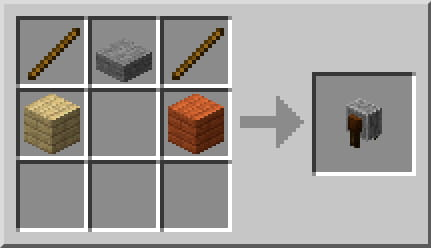
Ingredients: 2 Sticks + 1 Stone Slab + 2 Wooden Planks
The recipe requires the following elements, all accessible very early in progression:
2 Sticks: crafted from any type of wooden plank.
1 Stone Slab: 3 stone blocks give 6 slabs in a crafting table.
2 Wooden Planks: any type of wood works, the planks do not need to be of the same wood.
Crafting Pattern
Arrange the items in the crafting table as follows:
Stick   Slab   Stick
Plank          Plank
(Top row: Stick on the left, Stone Slab in the center, Stick on the right. Middle row: Plank on the left, center slot empty, Plank on the right. Bottom row: empty.)
Can Also Be Found in Villages
If you come across a village before having access to a crafting table, there's a good chance a Grindstone is already present in the Weaponsmith's house. You can collect it directly with an axe or any tool, with no need to mine it with a specific tool. It is also present in some dungeons and structures.
How to Repair a Tool with the Grindstone
Repairing via the Grindstone is an alternative to the anvil with distinct advantages and disadvantages.
Combine 2 Identical Tools to Restore Durability
Open the Grindstone interface (right-click): two input slots appear on the left, and the result on the right. Place two tools or weapons of the same type and material in the two slots. The Grindstone combines their remaining durability and adds a 5% bonus to the item's maximum durability.
For example, two iron swords each worn down to 50% durability will give an iron sword with about 105% durability (100% + 5% bonus). This bonus is modest but not negligible on expensive items.
Loss of Enchantments During Repair
This is the critical point to understand: all enchantments present on both merged tools are removed when repairing via the Grindstone. If you combine two enchanted swords, the enchantments disappear and you recover part of the associated XP. That's why the Grindstone is reserved for tools without enchantments or whose enchantments are not worth keeping.
Never combine two valuable enchanted items in the Grindstone if you want to keep the enchantments. To repair an enchanted item without losing its enchantments, use the Anvil with the correct repair material.
Comparison: Grindstone vs Anvil for Repair
| Criteria | Grindstone | Anvil |
|---|---|---|
| XP Cost | None | Yes (enchantment levels) |
| Keeps Enchantments | No | Yes |
| Durability Bonus | +5% | Variable |
| Required Materials | 2 identical items | Item + repair material |
| Anvil Penalty | No | Yes (increases with each repair) |
The Grindstone is ideal for recycling worn-out tools with no enchantment value. The anvil is essential as soon as your items have enchantments to preserve. For explanations on enchantments themselves, our guide to Minecraft leggings enchantments gives a good example of the priorities to adopt for each piece.
How to Disenchant with the Grindstone
Disenchanting is the second major use of the Grindstone, and often the most profitable.
Recovering Part of the XP from Enchantments
To disenchant an item, place it alone in one of the two input slots of the Grindstone, with nothing in the other slot. The Grindstone removes all enchantments from the item and gives you an amount of XP proportional to the value of the removed enchantments, in the form of experience orbs that appear directly at your feet.
The amount of XP recovered is not total: the Grindstone returns about 50 to 80% of the XP initially invested in the enchantments. It's always more profitable than simply throwing the item away.
Cursed Enchantments Cannot Be Removed
This is the main limitation of the Grindstone: curse enchantments, Curse of Vanishing and Curse of Binding, cannot be removed by the Grindstone. If an item has a curse, it remains even after passing through the Grindstone, whether or not the other enchantments have been removed. There is no way in vanilla to remove a curse from an item. The only option is to let the item break naturally or use it until it breaks.
Tip: Recycle XP from Found Items
The Grindstone is especially useful for making use of low-quality enchanted items found in structure chests. Rather than throwing away an iron sword with Sharpness I found in a dungeon, run it through the Grindstone to recover a few XP levels. On an intense exploration session, this practice can yield several dozen extra experience levels effortlessly.
Grindstone vs Anvil vs Enchanting Table
These three blocks form the central trio for enchantment management in Minecraft. Each has a specific role and they are complementary rather than competitors.
Comparison Table of the 3 Tools
| Function | Grindstone | Anvil | Enchanting Table |
|---|---|---|---|
| Enchant an item | No | Yes (via books) | Yes (random) |
| Repair without losing enchantments | No | Yes | No |
| Disenchant | Yes | No | No |
| XP Cost | None | Yes | Yes |
| Material Cost | 2 identical items | Repair material | Lapis Lazuli |
| Increasing Penalty | No | Yes (anvil penalty) | No |
When to Use the Grindstone Instead of the Anvil?
Use the Grindstone in these specific situations:
To recycle items without useful enchantments: broken or worn-out tools with no enchantment value, low-level loot items.
To quickly recover XP: if you need XP to enchant at the enchanting table and have expendable enchanted items, the Grindstone is faster than a furnace.
To prepare an item before re-enchanting: if an item has an undesirable enchantment and you want to start over, the Grindstone resets it to a blank state (enchantments removed, durability restored if you combined two copies).
Avoid the Grindstone if your item has valuable enchantments like Efficiency V, Fortune III, or Mending: go straight to the Anvil with the correct repair material.
Optimal Workflow for Enchanting and Repairing
Here is the recommended workflow for efficiently managing your equipment:
- Enchant your new items at the Enchanting Table (Lapis Lazuli + XP)
- Upgrade with enchanted books via the Anvil if needed
- Repair with the Anvil using the corresponding material (diamond, iron, etc.) to keep enchantments
- Recycle items with no value at the Grindstone to recover XP
- Reinvest the recovered XP into new enchantments at the Table
If you're looking to optimize your enchantments before facing bosses like the Wither, our guide on how to summon and defeat the Wither in Minecraft details the exact equipment to prepare.
Minecraft Grindstone FAQ
Does the Grindstone remove curses?
No. The curses Curse of Vanishing and Curse of Binding are the only enchantments that the Grindstone cannot remove. They remain on the item even if all other enchantments have been removed. There is no block or mechanic in vanilla that allows you to get rid of a curse: the only way out is to let the item wear out until it breaks. If you find an item with Curse of Vanishing (the item disappears when you die), never put it in your main inventory during a risky fight.
How much XP do you get back with the Grindstone?
The amount of XP returned by the Grindstone depends directly on the enchantments removed. It varies according to the level and type of each enchantment. As a general rule, expect between 50% and 80% of the total XP invested. An item with several high-level enchantments (Fortune III, Efficiency V, Mending) can return 20 to 40 XP levels depending on the case. The Grindstone never gives back all the XP invested: there is always a partial loss, which is why you shouldn't disenchant expensive items lightly.
Can you disenchant books with the Grindstone?
Yes. Enchanted Books can be placed in the Grindstone to remove their enchantment and recover part of the XP. The book becomes a regular book again. This is useful if you have low-level enchanted books cluttering your chests and whose enchantments aren't worth using. On the other hand, if the book contains a rare or useful enchantment (Silk Touch, Fortune III, Sharpness V), keep it safe or use it via an Anvil rather than destroying it in the Grindstone.
Optimize your enchanting and repair system with your friends on a free Minecraft server, or check out our Minecraft hosting offers for a smooth, lag-free multiplayer experience, deployed in 2 minutes on OuiHeberg.