
 Client area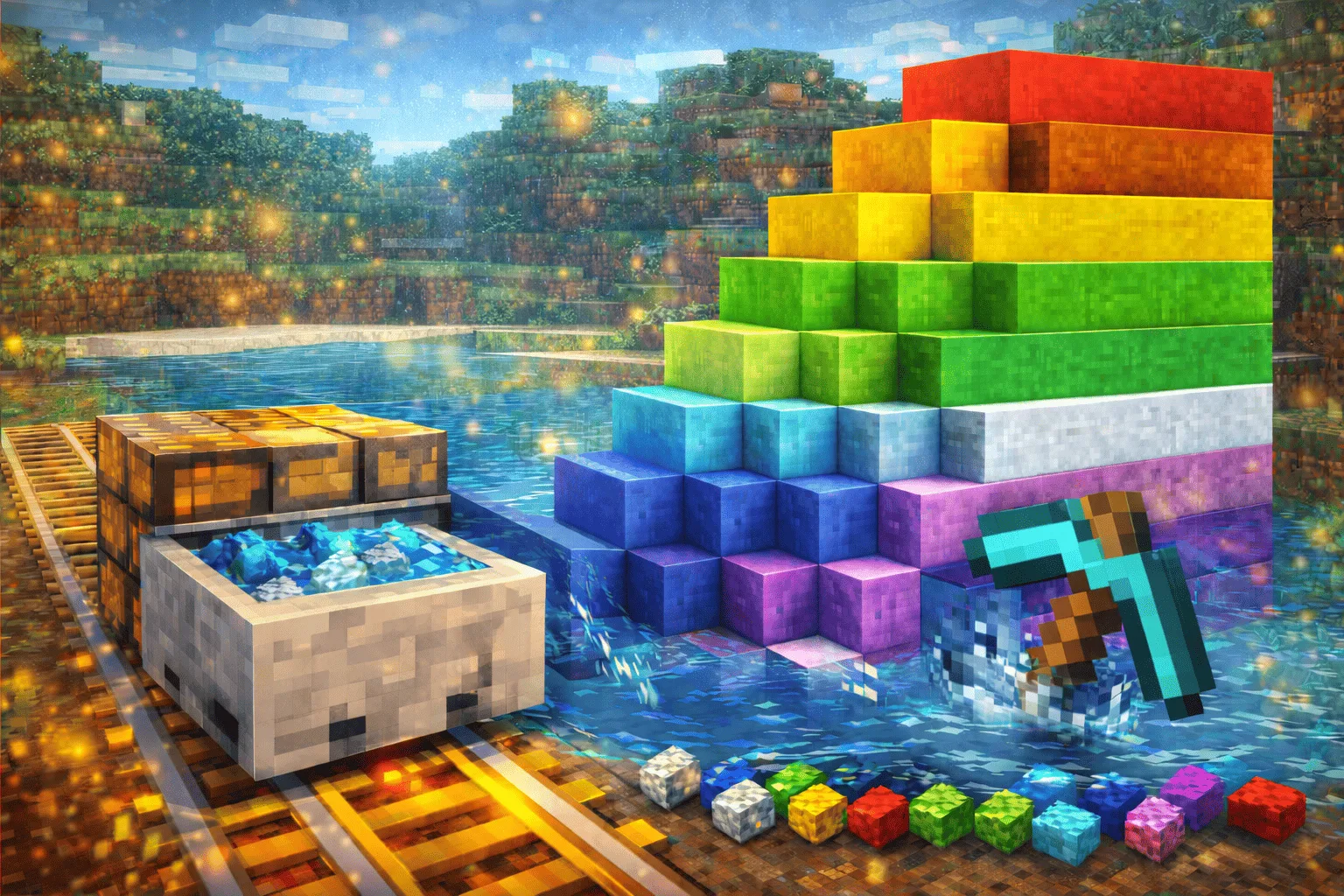
Minecraft Concrete: Crafting, Colors, and Uses
Minecraft concrete is one of the most popular building blocks in the game. Introduced in the World of Color update in June 2017, it offers 16 bright and saturated colors, a smooth texture without patterns, and fire resistance that wool does not have. Whether you're building a modern house, giant pixel art, or a colorful building on a multiplayer server, concrete is the ideal material.
This guide explains how to make Minecraft concrete step by step: crafting concrete powder, hardening with water, and the 16 color variants available in 2026.
How to Craft Concrete Powder
Concrete is made in two steps. The first step is to craft concrete powder on a crafting table.
The recipe is shapeless, meaning the order of ingredients in the grid does not matter. Simply place the three components in the 3×3 grid: 4 sand blocks, 4 gravel blocks, and 1 dye of the desired color. This recipe produces 8 blocks of concrete powder.
Sand is abundant in deserts, on beaches, and at the bottom of oceans. Gravel is common underground, on beaches, in rivers, and in gravelly hills biomes. A shovel with the Efficiency enchantment significantly speeds up the collection of both materials.
Concrete powder is a block affected by gravity (like sand and gravel): it falls if no solid block supports it. This behavior is exploited in the rapid production methods described below.
Transforming Powder into Concrete (Water)
The second step transforms the powder into solid concrete. For this, the concrete powder must come into contact with water: a source block, flowing water, or a waterlogged block.
Three methods work: placing the powder directly in water (it solidifies instantly), placing the powder next to a water block (lateral contact), or letting the powder fall into water from a height (it hardens upon landing).
Note: rain, water bottles, and cauldrons do not harden concrete powder. Only direct contact with a water block works.
Once hardened, the concrete must be mined with a pickaxe to be retrieved (without a pickaxe, it does not drop). A diamond or netherite pickaxe with Efficiency V allows for almost instant mining of concrete, which is essential for mass production.
The fastest production method is to build a one-block tower above a body of water, stand on it, and place the concrete powder downward. The powder falls into the water and hardens immediately. Then, simply mine the stacked concrete blocks at the bottom of the water. This technique allows converting several stacks of powder in a few minutes.
The 16 Colors of Concrete
Minecraft concrete comes in 16 colors, one for each dye in the game. The color is determined by the dye used when crafting the powder. Once the concrete is hardened, its color is permanent and cannot be changed.
| Color | Dye | Dye Source |
|---|---|---|
| White | White Dye | Lily of the Valley or Bone Meal |
| Light Gray | Light Gray Dye | Azure Bluet, Oxeye Daisy, or White Tulip |
| Gray | Gray Dye | Black Dye + White Dye |
| Black | Black Dye | Ink Sac (Squid) or Wither Rose |
| Brown | Brown Dye | Cocoa Beans |
| Red | Red Dye | Poppy, Red Tulip, Rose Bush, or Beetroot |
| Orange | Orange Dye | Orange Tulip, or Red + Yellow Dye |
| Yellow | Yellow Dye | Dandelion or Sunflower |
| Lime | Lime Dye | Green + White Dye, or Cooked Sea Pickle |
| Green | Green Dye | Cactus cooked in a furnace |
| Cyan | Cyan Dye | Blue + Green Dye |
| Light Blue | Light Blue Dye | Blue Orchid, or Blue + White Dye |
| Blue | Blue Dye | Lapis Lazuli or Cornflower |
| Purple | Purple Dye | Blue + Red Dye |
| Magenta | Magenta Dye | Lilac, Allium, or Purple + Pink Dye |
| Pink | Pink Dye | Pink Tulip, Peony, or Red + White Dye |
All dyes are renewable: flowers can be grown with bone meal, squids spawn naturally, and cacti grow indefinitely. For large-scale projects, an automatic flower farm (bone meal + dispenser on a dirt block) allows mass production of dyes.
Construction Uses
Concrete stands out from other colored blocks with several advantages that make it a favorite among experienced builders.
Compared to wool, concrete offers brighter and more saturated colors, does not burn (total fire resistance), and has a perfectly smooth texture without the fibrous pattern of wool. Compared to terracotta, concrete offers purer and more uniform shades (terracotta has earthier tones and a visible pattern), although glazed terracotta remains unbeatable for decorative patterns.
Concrete is particularly suitable for modern and contemporary constructions (smooth and colorful walls), pixel art and murals (bright and uniform colors), floors and interior coverings (clean texture), buildings on multiplayer servers (fire resistance = no griefing by fire), and adventure maps and parkours (visual markers by color).
For large multiplayer construction projects, a high-performance server makes all the difference. Check out our Minecraft hosting offers for an optimized server with NVMe SSD storage, ideal for massive builds.
Concrete FAQ
Does concrete have the same explosion resistance as stone?
Concrete has an explosion resistance of 1.8, slightly lower than stone (6.0). It does not withstand explosions from creepers or TNT. For explosion-resistant construction, prefer obsidian or reinforced blackstone bricks.
Can you dye already hardened concrete?
No. The color is set during the crafting of the powder and cannot be changed afterward. If you want to change the color, you must break the block and craft a new powder with the desired dye.
How to make Minecraft concrete in large quantities quickly?
The most efficient method is the conversion tower: stack yourself above a body of water, place the powder downward (it falls and hardens), then mine the concrete column at the bottom. With an Efficiency V pickaxe and Haste II (via beacon), you can convert and mine several hundred blocks in a few minutes.
Does concrete exist in slabs or stairs?
No. In vanilla, concrete is only available as a full block. There are no slabs, stairs, walls, or pillars in concrete (Minecraft concrete). Mods like Quark or Supplementaries add these variants for players seeking more architectural flexibility.