
 Client area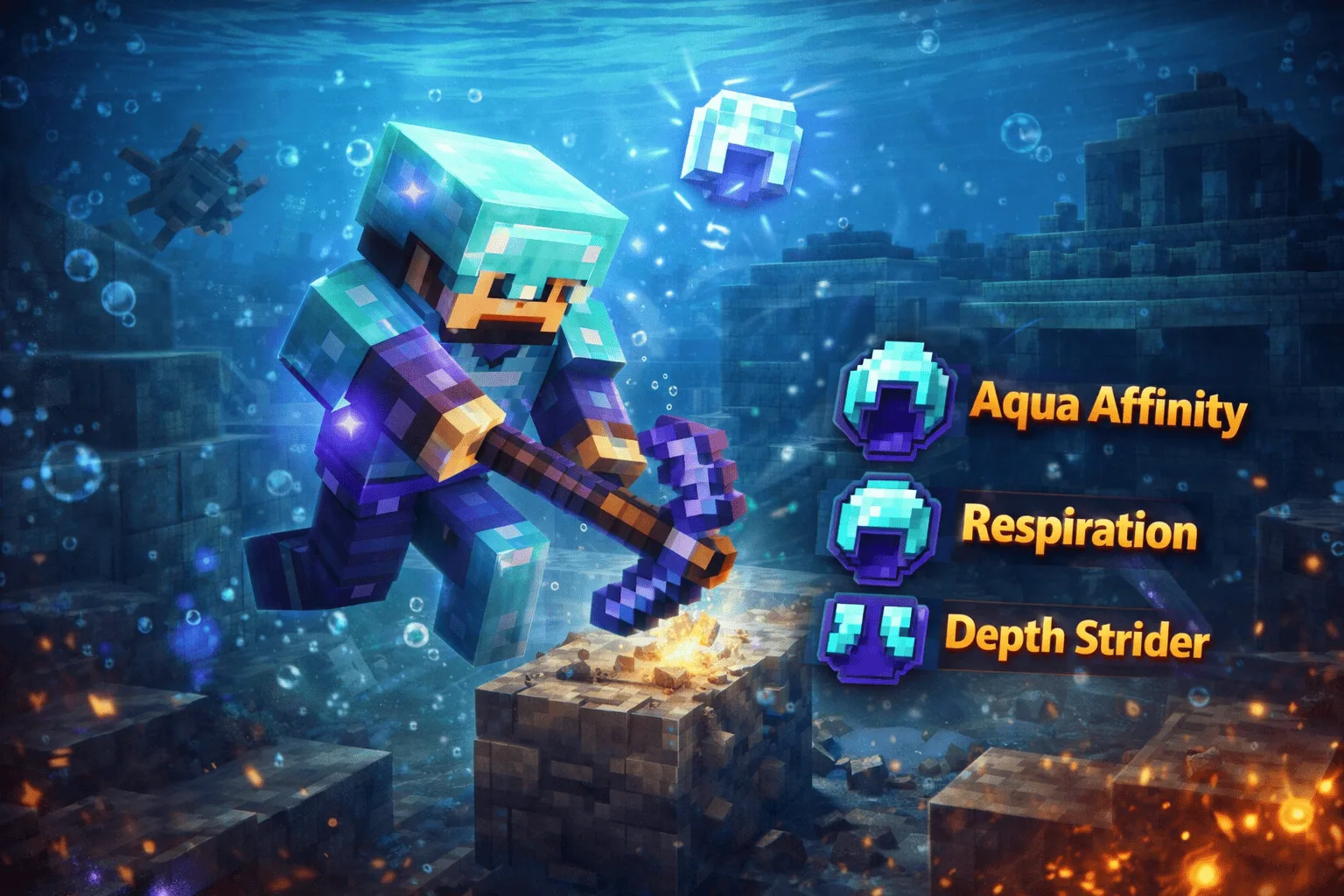
The aqua affinity minecraft enchantment is often underestimated by players who focus on classic offensive or defensive enchantments. However, when it comes to mining underwater, it's one of the most impactful enchantments in the game. Without it, breaking a submerged block takes about five times longer than on the surface. With it, the mining speed underwater becomes identical to that on land. This guide covers everything you need to know about the aqua affinity minecraft enchantment in 2026: how it works, how to obtain it, underwater structures to explore, and the optimal combination for the perfect helmet.
Aqua Affinity: what is this helmet enchantment for?
Aqua Affinity is an enchantment exclusive to helmets (and turtle shells). It exists only at one level, making it simple to understand: either you have it, or you don't.
In Minecraft, mining a block underwater applies a speed penalty ×5 compared to mining on the surface. Specifically, a stone block that takes 0.75 seconds to break with an Efficiency V diamond pickaxe on land requires about 3.75 seconds underwater. Aqua Affinity completely removes this penalty: the mining speed underwater becomes strictly identical to that on land.
There is a second mining penalty that applies when the player is not touching the ground (floating). This penalty is an additional ×5 multiplier, independent of the aquatic penalty. Aqua Affinity does not remove this second penalty. To mine at full speed underwater, you must have your feet on a solid block. If you float between two waters, mining remains slow despite Aqua Affinity.
In summary: Aqua Affinity cancels the penalty related to water, not the one related to floating. Settle on the seabed or on a block before mining to fully benefit from the enchantment.
How to obtain Aqua Affinity (table, libraries, fishing, trading)
Since Aqua Affinity is a single-level enchantment (no levels I to V), it is relatively easy to obtain compared to enchantments like Efficiency V or Protection IV.
Enchantment table: this is the most direct method. Place a helmet in the enchantment table surrounded by 15 bookshelves. Aqua Affinity can appear as early as slot 1 (level 1) but the chances increase with higher slots. With a diamond helmet in slot 3 (level 30), Aqua Affinity appears frequently, often combined with Protection or Respiration.
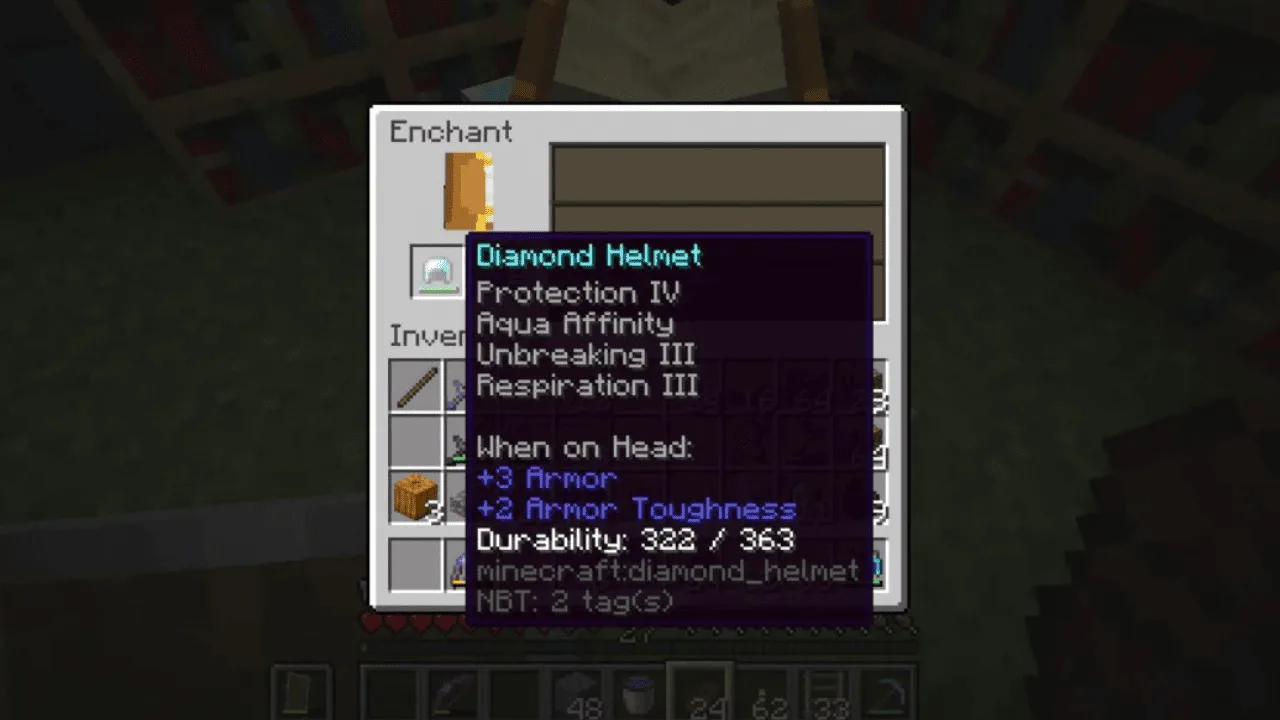
Enchanted books: books with Aqua Affinity can be found in dungeon chests, desert temples, jungle temples, Nether fortresses, bastions, and ancient cities. Then apply the book to a helmet via the anvil.
Librarian villagers: a novice librarian offers a random enchanted book as the first trade. Break and replace the lectern before confirming the first trade to reset the offer. Since Aqua Affinity has only one level, the chances of getting it are decent compared to multi-level enchantments.
Fishing: with a Luck of the Sea III enchanted rod, fishing can yield enchanted books containing Aqua Affinity. The probability remains low but it's a nice passive bonus during AFK fishing sessions.
Emerald trading: a librarian from novice to expert level can offer Aqua Affinity for a cost ranging from 5 to 64 emeralds depending on the villager's level and difficulty.
Aqua Affinity and aquatic exploration (underwater temples, shipwrecks)
Aqua Affinity is invaluable when exploring Minecraft's underwater structures. Several structures require breaking submerged blocks to access loot or progress.
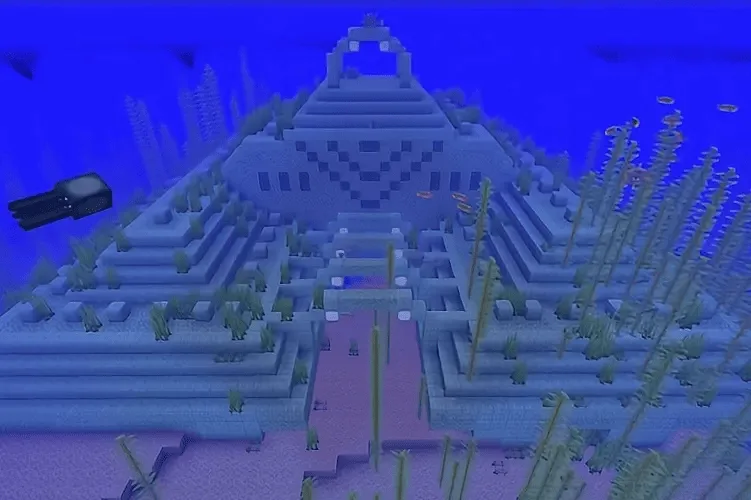
The Ocean Monuments are the most imposing underwater structures in the game. Guarded by Guardians and an Elder Guardian, they contain rooms filled with prismarine, sea lanterns, and especially 8 gold blocks hidden in the central treasure chamber. Breaking dark prismarine blocks to access the inner rooms without Aqua Affinity is extremely slow. With the enchantment, dismantling an entire monument (for its prismarine) becomes a feasible project.
Shipwrecks contain chests in their hold and cabin. Some are partially buried in the seabed sand, and you sometimes need to dig to reach the chests. Aqua Affinity significantly speeds up this process.
Ocean Ruins are small stone or sandstone structures submerged underwater. Their chests are often accessible without mining, but larger ruins require breaking blocks to make a path.
Conduits are activatable blocks that offer the Conduit Power effect within a radius around them, granting underwater night vision, breathing, and increased mining speed. To build and activate a conduit, you need to assemble a prismarine frame underwater, which involves placing and breaking submerged blocks. Aqua Affinity facilitates the construction of this structure.
Combining Aqua Affinity + Respiration + Depth Strider
Aqua Affinity solves the mining speed problem, but underwater exploration poses two other major challenges: limited breathing time and reduced movement speed. Three enchantments form the essential underwater trio.
Aqua Affinity (helmet): removes the underwater mining penalty. Essential for any submerged construction or destruction operation.
Respiration III (helmet): increases underwater breathing time. Without enchantment, the air gauge lasts 15 seconds. Each level of Respiration adds 15 seconds, totaling 60 seconds with Respiration III. Additionally, between each lost bubble, Respiration adds a delay before suffocation damage, giving a few extra seconds.
Depth Strider III (boots): increases underwater movement speed. At level III, swimming speed becomes almost equivalent to walking speed on land. Without this enchantment, moving underwater is slow and frustrating, especially in large Ocean Monuments.
For surface and air travel, the Elytra remains unbeatable, but underwater, Depth Strider is the only viable solution.
These three enchantments complement each other perfectly as they apply to different armor pieces (helmet for the first two, boots for the third) and are never in conflict. There is no reason not to have all three on underwater exploration gear.
The Turtle Shell is an interesting alternative to the classic helmet. It grants the Water Breathing effect for 10 seconds upon entering the water, in addition to accepting Aqua Affinity and Respiration like a normal helmet. However, its base protection (2 points) is lower than that of a diamond helmet (3 points) or Netherite (3 points + knockback resistance).
The perfect underwater helmet: recommended combination
Here is the complete list of enchantments for a helmet dedicated to underwater exploration, in order of priority:
Essential enchantments: Aqua Affinity + Respiration III + Protection IV (or Projectile Protection IV for Guardians). These three enchantments cover fast mining, extended breathing time, and damage reduction.
Recommended enchantments: Unbreaking III (increased durability) + Mending (automatic repair via XP). A helmet with Mending never breaks if you regularly collect XP, which is ideal for long underwater sessions.
Optional enchantment: Thorns III (returns damage to attackers). Useful against Guardians who attack in melee, but consumes durability faster. With Mending, this is not a problem.
The complete combination on the anvil is: Aqua Affinity + Respiration III + Protection IV + Unbreaking III + Mending. To assemble it efficiently, first combine Protection IV + Respiration III on a book, then Unbreaking III + Aqua Affinity on a second book, merge the two books, apply the result to the helmet, and add Mending last. This makes 3 operations on the helmet, far from the "Too expensive!" threshold.
For the boots, complete with Depth Strider III + Protection IV + Unbreaking III + Mending. Note that Depth Strider and Frost Walker are mutually exclusive: choose Depth Strider for underwater exploration.
On a multiplayer server, organizing an underwater expedition with several players equipped with this set is formidable for clearing an Ocean Monument in a few minutes. A Minecraft hosting with enough RAM ensures smooth loading of ocean chunks, which often contain many entities (fish, Guardians, drowned).
FAQ Aqua Affinity
Does Aqua Affinity have multiple levels?
No. Aqua Affinity exists only at one level. There is no Aqua Affinity II or higher. The effect is binary: either the underwater mining penalty is removed, or it is not.
Does Aqua Affinity work on the turtle shell?
Yes. The turtle shell accepts all helmet enchantments, including Aqua Affinity and Respiration. It offers the bonus Water Breathing effect for 10 seconds upon entering the water.
Does Aqua Affinity speed up mining while floating?
No. Aqua Affinity only removes the penalty related to water. If the player is not touching the ground (floating), a separate ×5 penalty remains active. Settle on a solid block to mine at full speed.
Can Aqua Affinity and Respiration be combined on the same helmet?
Yes. The two enchantments are perfectly compatible and complement each other. Aqua Affinity handles mining, Respiration handles breathing duration. Both apply to the helmet.
Does Aqua Affinity work outside of water?
No. Outside of water, Aqua Affinity has no effect. It does not change mining speed on land, in the Nether, or in the End.
What is the best helmet material for Aqua Affinity?
The Netherite helmet is the best overall choice (maximum protection, knockback resistance, does not burn in lava). The diamond helmet is the alternative if you do not yet have access to Netherite. The turtle shell is a niche choice for the Water Breathing bonus.
Does Aqua Affinity work on Bedrock Edition?
Yes. Aqua Affinity is available and works identically on Java Edition and Bedrock Edition.