
 Client area
Minecraft Enchantment Table: Complete Guide + Galactic Language
The Minecraft enchantment table is the central block of the equipment enhancement system in survival mode. It transforms an ordinary diamond sword into a formidable weapon and a regular pickaxe into a tool capable of retrieving intact ores. However, between the placement of bookshelves, the necessary XP levels, and the mysterious symbols floating around the block, many players only exploit a fraction of the potential of the Minecraft enchantment table. This guide covers everything you need to know in 2026: crafting, mechanics, galactic alphabet, optimal room, complete enchantment table, and progression tips.
Crafting the Enchantment Table and Placing Bookshelves
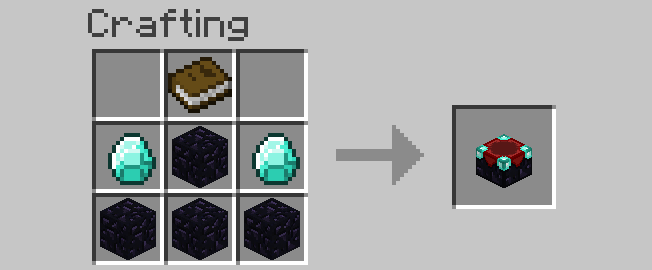
The recipe for the enchantment table requires three materials: 1 book, 2 diamonds, and 4 blocks of obsidian. On the 3x3 crafting grid, place the book in the center of the top row, a diamond to the left and a diamond to the right of the middle row with a block of obsidian in the center, then three blocks of obsidian across the entire bottom row.
To mine obsidian, you will need a diamond or netherite pickaxe. Pour a bucket of water over source lava to create the blocks, then mine them (about 9.4 seconds per block without Efficiency enchantment). The book is crafted with 3 papers and 1 leather, and paper is made from sugar cane (3 canes = 3 papers).
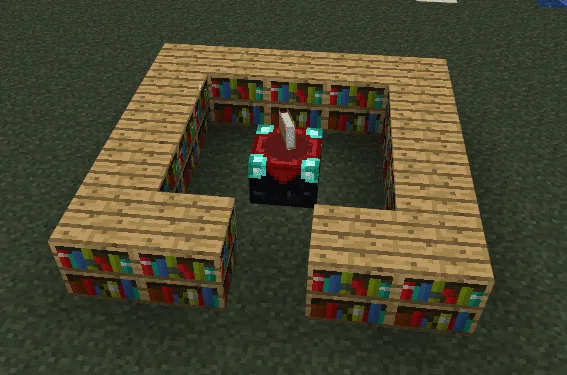
The enchantment table works alone, but its enchantments are capped at level 8. To unlock higher levels up to the maximum of 30, it must be surrounded by bookshelves. Each bookshelf is crafted with 6 wooden planks (top and bottom rows) and 3 books (middle row). The number of bookshelves influencing the table is capped at 15: beyond that, additional ones have no effect.
The bookshelves must follow two placement rules. First, they must be exactly 2 blocks laterally from the table (one block of air between the bookshelf and the table). Second, they must be at the same level as the table or one block above. No block, even transparent (torch, carpet, snow, slab), should be in the air space between the table and the bookshelves, as it would block the connection.
How XP Levels and Enchantment Slots Work
When you place an enchantable item on the table, three options appear in the interface. Each option has a cost in experience levels and lapis lazuli.
The slot 1 (basic enchantment) costs 1 XP level and 1 lapis lazuli. The slot 2 (intermediate) costs 2 levels and 2 lapis lazuli. The slot 3 (advanced) costs 3 levels and 3 lapis lazuli. Hovering over an option displays a preview enchantment, but other enchantments may randomly be added to the final result.
The green number displayed to the right of each slot is the minimum level required to access that option, not the total cost. For example, if slot 3 shows "30", you must have at least 30 levels, but the enchantment only consumes 3. The remaining 27 levels are retained.
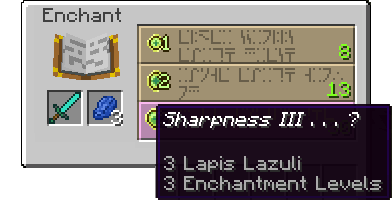
The power of the proposed enchantments directly depends on the number of active bookshelves. With 0 bookshelves, the maximum displayed level does not exceed 8. With 15 bookshelves, it reaches 30, unlocking the most powerful enchantments in the game (Sharpness V, Protection IV, Efficiency V, etc.).
The three options are randomly generated from a seed that changes each time you enchant an item. If none of the three proposals suit you, enchant a low-cost item (a wooden shovel, for example) in slot 1 for 1 level and 1 lapis, which resets the proposals for all items.
The Galactic Language: Complete Translation of the Standard Galactic Alphabet
The mysterious symbols floating between the bookshelves and the table, as well as the runes displayed in the enchantment interface, are written in the Standard Galactic Alphabet (SGA). This alphabet comes from the Commander Keen video game series, developed by id Software in 1990. Tom Hall, the game's designer, created it to decorate alien signs.
Mojang integrated the SGA into Minecraft during Beta 1.9 Pre-release 3 in 2011 to give a mystical aspect to the enchantment table. The principle is simple: each symbol replaces a letter of the Latin alphabet. It is a direct substitution cipher, letter by letter.
Here is the complete correspondence of the 26 letters:
| Letter | SGA Symbol | Letter | SGA Symbol |
|---|---|---|---|
| A | ᔑ | N | リ |
| B | ʖ | O | 𝙹 |
| C | ᓵ | P | !¡ |
| D | ↸ | Q | ᑑ |
| E | ᒷ | R | ∷ |
| F | ⎓ | S | ᓭ |
| G | ⊣ | T | ℸ ̣ |
| H | ⍑ | U | ⚍ |
| I | ╎ | V | ⍊ |
| J | ⋮ | W | ∴ |
| K | ꖌ | X | ̇/ |
| L | ꖎ | Y | |
| M | ᒲ | Z | ⨅ |
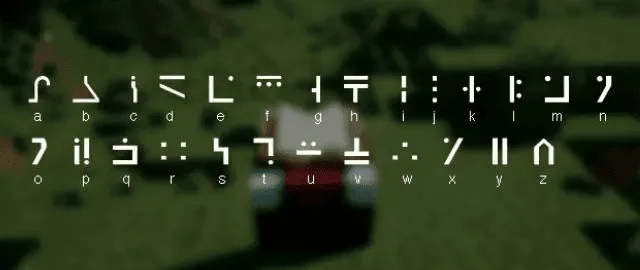
The runes in the enchantment interface are constructed by picking 3 to 5 random words from a predefined list, then converting them to SGA. Among the words in this list: "air", "animal", "wand", "ball", "beast", "cold", "creature", "cthulhu", "cube", "curse", "darkness", "demon", "destroy", "earth", "elder", "embiggen", "enchant", "fire", "free", "fresh", "galvanize", "grow", "hot", "humanoid", "ignite", "imbue", "inside", "klaatu", "light", "limited", "mental", "mist", "of", "other", "physical", "range", "scrolls", "self", "shorten", "shrink", "snuff", "sphere", "spirit", "stale", "stretch", "the", "thing", "torture", "undead", "water", "wet", "xyzzy".
The result is purely decorative: the displayed words have no relation to the applied enchantment and are not recorded on the enchanted item. The combination "the elder scrolls" is a nod to Bethesda, while "klaatu berata niktu" references the film The Day the Earth Stood Still (1951), and "phnglui mglwnafh cthulhu rlyeh wgahnagl fhtagn" comes from H.P. Lovecraft's The Call of Cthulhu.
Building the Perfect Enchantment Room (15 Bookshelves)
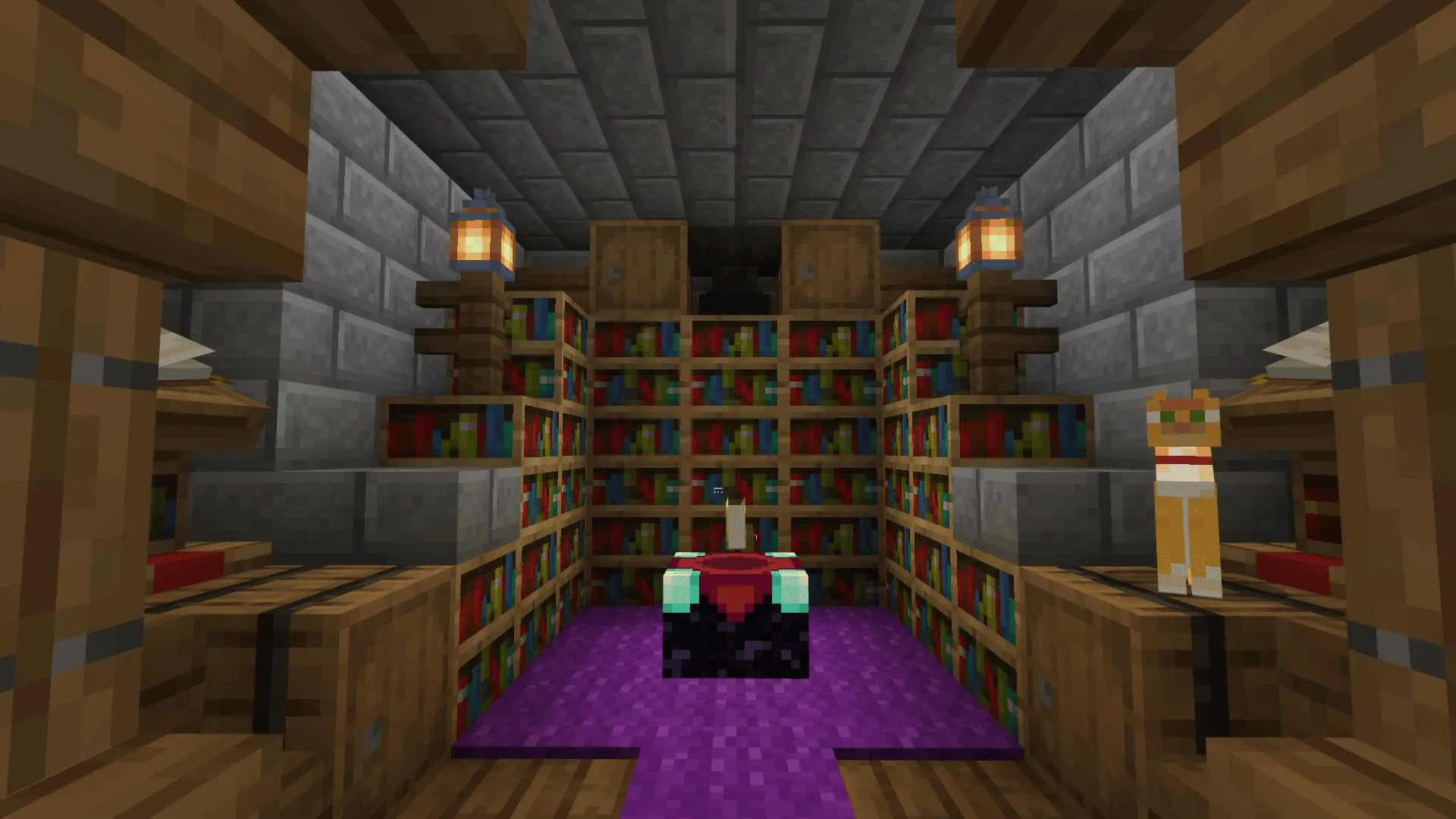
The simplest and most common layout is the 5x5 square. Place the enchantment table in the center, leave a ring of one block of air around it, then arrange the 15 bookshelves on the outer perimeter, leaving a one-block opening to enter.
Concretely, this results in a rectangle of bookshelves on three sides (5 + 4 + 4 = 13 bookshelves on a single layer) with two additional bookshelves on each side of the entrance, or a U-shaped configuration with stacking. Several arrangements are possible as long as the following rules are respected: the bookshelves are 2 blocks laterally from the table, at the same level or one block above, and nothing blocks the space between them and the table.
Stacking on 2 blocks high is perfectly valid. A popular configuration is to place a U of 7 bookshelves on the ground and 8 bookshelves on the second level (or vice versa), which frees up floor space for movement. Diagonal corner bookshelves also count, provided the diagonal space between the table and the bookshelf is clear.
A tip for players who want access to enchantments of varying levels without dismantling the bookshelves: place torches between the table and the shelves you want to deactivate. Removing the torches instantly restores the effect. This method allows switching between levels 1 to 30 without rebuilding the room.
On a multiplayer server, the enchantment room is often a shared space. A high-performance Minecraft hosting ensures that the chunks containing the room remain properly loaded and that multiple players can enchant simultaneously without lag.
 Enchantment Table by Item Type
Not all enchantments can be obtained via the enchantment table. Enchantments marked with an asterisk (*) are treasure enchantments: they can only be obtained through chests, fishing, trading with a villager, or enchanted books on an anvil. Mending is the most well-known among them.
| Item Type | Available Enchantments at the Table | Treasure Enchantments Only |
|---|---|---|
| Sword | Sharpness I-V, Smite I-V, Bane of Arthropods I-V, Knockback I-II, Fire Aspect I-II, Looting I-III, Sweeping Edge I-III (Java), Unbreaking I-III | Mending*, Curse of Vanishing* |
| Pickaxe | Efficiency I-V, Silk Touch, Fortune I-III, Unbreaking I-III | Mending*, Curse of Vanishing* |
| Axe | Sharpness I-V, Smite I-V, Bane of Arthropods I-V, Efficiency I-V, Silk Touch, Fortune I-III, Unbreaking I-III | Mending*, Curse of Vanishing* |
| Shovel | Efficiency I-V, Silk Touch, Fortune I-III, Unbreaking I-III | Mending*, Curse of Vanishing* |
| Hoe | Efficiency I-V, Silk Touch, Fortune I-III, Unbreaking I-III | Mending*, Curse of Vanishing* |
| Bow | Power I-V, Punch I-II, Flame, Infinity, Unbreaking I-III | Mending*, Curse of Vanishing* |
| Crossbow | Quick Charge I-III, Multishot, Piercing I-IV, Unbreaking I-III | Mending*, Curse of Vanishing* |
| Trident | Impaling I-V, Loyalty I-III, Channeling, Unbreaking I-III | Mending*, Riptide I-III*, Curse of Vanishing* |
| Mace (1.21+) | Smite I-V, Bane of Arthropods I-V, Fire Aspect I-II, Unbreaking I-III, Density I-V, Crack I-IV | Wind Gust I-III*, Mending*, Curse of Vanishing* |
| Helmet | Protection I-IV, Fire Protection I-IV, Blast Protection I-IV, Projectile Protection I-IV, Respiration I-III, Aqua Affinity, Thorns I-III, Unbreaking I-III | Mending*, Curse of Binding*, Curse of Vanishing* |
| Chestplate | Protection I-IV, Fire Protection I-IV, Blast Protection I-IV, Projectile Protection I-IV, Thorns I-III, Unbreaking I-III | Mending*, Curse of Binding*, Curse of Vanishing* |
| Leggings | Protection I-IV, Fire Protection I-IV, Blast Protection I-IV, Projectile Protection I-IV, Thorns I-III, Unbreaking I-III | Mending*, Swift Sneak I-III*, Curse of Binding*, Curse of Vanishing* |
| Boots | Protection I-IV, Fire Protection I-IV, Blast Protection I-IV, Projectile Protection I-IV, Feather Falling I-IV, Depth Strider I-III, Thorns I-III, Unbreaking I-III | Mending*, Frost Walker I-II*, Soul Speed I-III*, Curse of Binding*, Curse of Vanishing* |
| Fishing Rod | Lure I-III, Luck of the Sea I-III, Unbreaking I-III | Mending*, Curse of Vanishing* |
| Shears | Efficiency I-V, Unbreaking I-III | Mending*, Curse of Vanishing* |
Incompatibilities to Know: Silk Touch and Fortune cannot coexist on the same tool. Infinity and Mending are mutually exclusive on a bow. The four types of Protection (normal, fire, explosions, projectiles) cannot be combined on the same piece of armor. Loyalty/Channeling and Riptide are incompatible on a trident.
Tips to Maximize Enchantments (XP Farm, Books)
Enchanting at level 30 quickly consumes experience. The most efficient method to accumulate levels is to build an automatic XP farm. Mob farms (based on zombie or skeleton spawners) and Endermen farms in the End are the most popular. With a good farm, reaching level 30 takes less than two minutes.
Trading with librarian villagers is the second essential strategy.
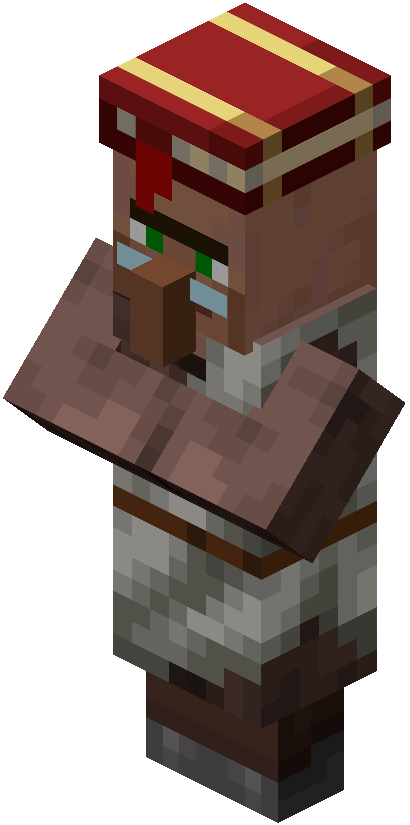
A novice-level librarian offers a random enchanted book as the first offer. If the offer does not suit you, break and replace their lectern before validating the first trade to reset their offers. This manipulation allows targeting specific enchantments, including treasure enchantments like Mending or Silk Touch.
To combine enchantments on the anvil without exploding costs, follow the fusion order.
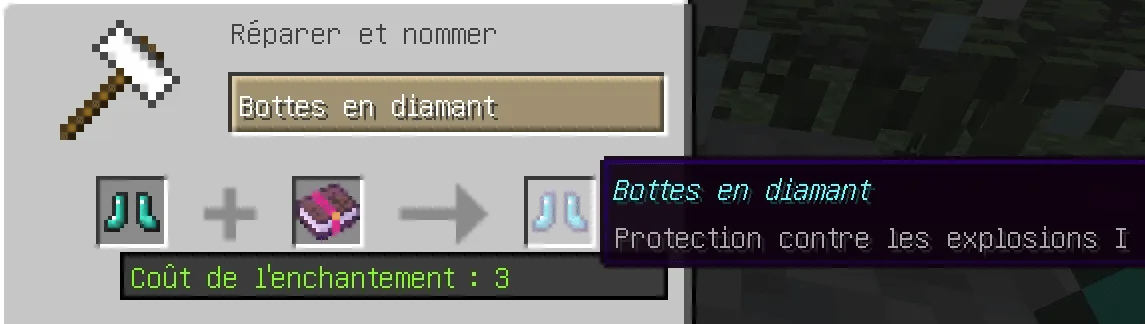
Always combine items with a similar number of prior repairs (prior work penalty). The item in the first slot retains its name and base enchantments; the one in the second slot provides additional enchantments. The cost in levels increases exponentially with the number of fusions. Beyond 6 operations on the same item, the anvil displays "Too Expensive!" and refuses the operation.
The grindstone is useful for recycling unwanted enchantments. It removes all enchantments from an item and returns some of the invested XP. It also resets the prior work penalty but removes the enchantments in the process.
Final tip: enchant books first rather than directly the final item. A book accepts any enchantment in the game, increasing your chances of getting a rare enchantment. You can then store the book and apply it on the anvil when desired.
Enchantment Table FAQ
Can you move an enchantment table?
Yes. In Java Edition, it must be mined with a pickaxe (any material). In Bedrock Edition, it can be broken by hand. It does not lose any properties when replaced.
How much lapis lazuli is needed in total?
For an enchantment in slot 3, 3 lapis lazuli are needed per operation. Lapis lazuli is found between Y = -64 and Y = 64, with a maximum concentration around Y = -1.
Are the enchantments on the table truly random?
They depend on a pseudo-random seed linked to the player. This seed changes each time an item is enchanted. The three proposals are therefore not entirely random but determined by an algorithm based on the table level, the number of bookshelves, and the player's seed.
Why doesn't my table offer level 30?
Check three things: you have 15 bookshelves, no block (even a torch or carpet) is between the bookshelves and the table, and the bookshelves are at the correct level (same height as the table or one block above).
Does the galactic language reveal the enchantment before paying?
No. The Standard Galactic symbols displayed in the interface are random English words, with no link to the proposed enchantment. The only real clue is the name of the enchantment displayed when hovering over the slot.
Enchantment table or librarian villager?
Both are complementary. The table is ideal for combined enchantments (a single slot can apply multiple enchantments simultaneously) and common enchantments. The villager is better for targeting a specific enchantment, especially treasure enchantments like Mending, which never appear on the table.
Can you enchant in multiplayer on the same server?
Yes. Each player has their own enchantment seed. Two players using the same table will see different proposals. The table does not wear out and can be used indefinitely.