
 Client area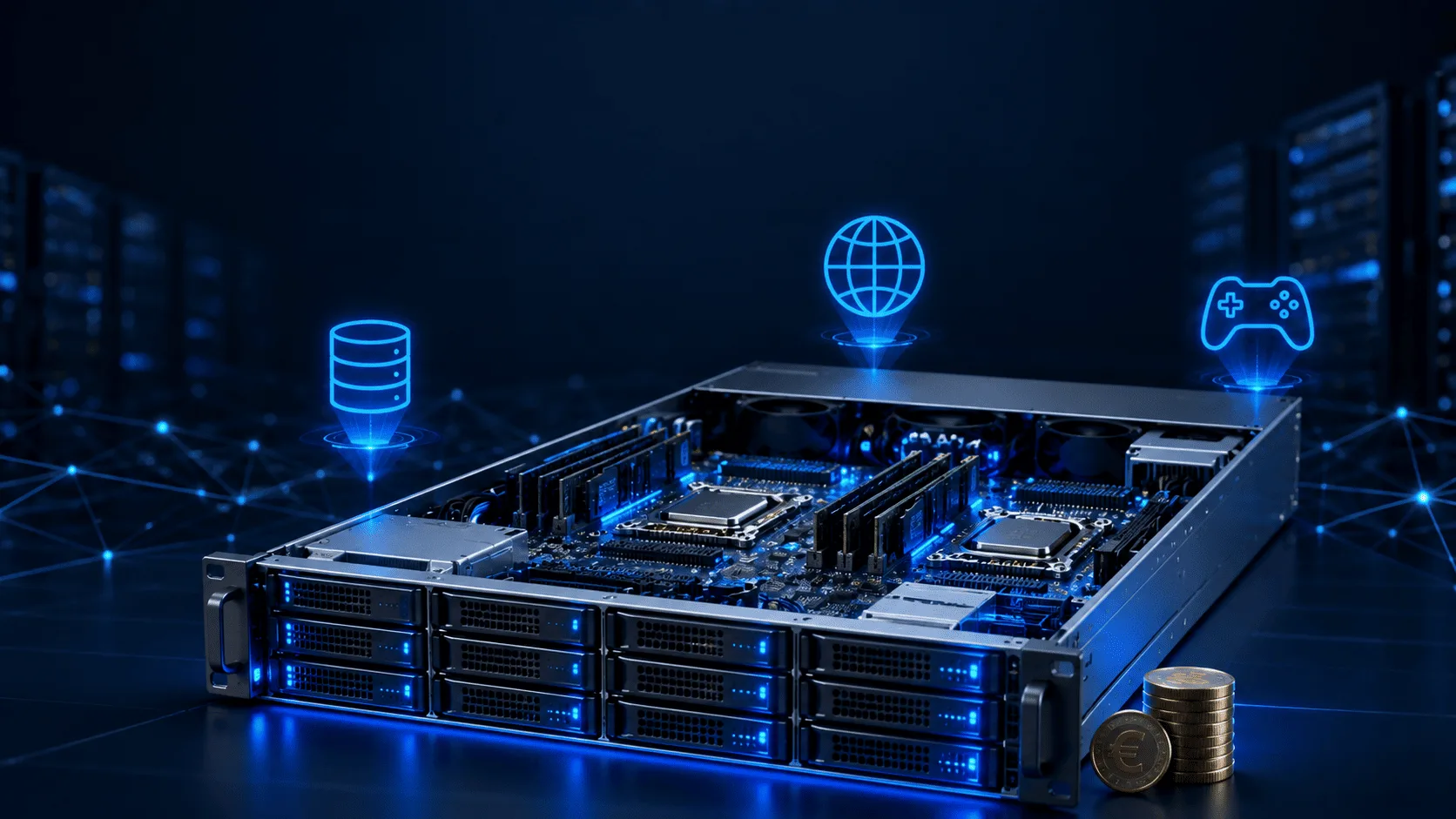
Editorial transparency - This guide is written by the OuiHeberg team, a hosting provider offering VPS and dedicated servers. The technical and pricing data mentioned come from verifiable public sources (July 2026). Our recommendations are based on our operational experience with both architectures.
Written by Arthur G. - OuiHeberg team
The term "bare metal" is used by OVHcloud, Scaleway, AWS, Google Cloud - sometimes to refer to a classic dedicated server, sometimes to a cloud instance without a hypervisor. As a result, the word has become more of a marketing argument than a precise technical definition. This article untangles what "bare metal" really means, how it differs from a VPS or a classic dedicated server, and when it actually makes a difference for you.
Bare metal: what it really means
A bare metal server is a physical machine dedicated to a single client, with no virtualization layer between the hardware and the operating system. The OS runs directly on the metal - "bare" literally means "naked." No hypervisor, no neighbors, no software abstraction layer between your workload and the silicon.
Concrete consequences: 100% of CPU cores are available, ECC RAM is fully allocated, disk I/O is not shared with other instances. Performance is predictable because no hypervisor scheduler interferes with your processes.
The confusion arises in the marketing use of the term. In practice:
- "Bare metal cloud" (AWS Bare Metal, GCP Bare Metal Solution, Scaleway Elastic Metal): dedicated physical server provisioned via API, billed by the hour - it's dedicated hardware with a cloud interface.
- "Dedicated server" (OVHcloud, OuiHeberg dedicated servers): same physical architecture, often billed weekly or monthly, without automated provisioning API.
The term "bare metal" does not imply any technical superiority over "dedicated server" - it's the same hardware, just a different name. The real variable is the provisioning method and billing model, not raw performance.
Field feedback - A common paradox: a notable share of dedicated clients install Proxmox or KVM on top of their bare metal to recreate their own virtualization layer. Bare metal is not the enemy of virtualization - it gives you back control: you decide the VM density, not your hosting provider.
Bare metal vs VPS vs dedicated server: the real differences
The table below compares the three architectures based on criteria that matter in production. VPS prices are for the Linux NVMe VPS from €1.80/month incl. VAT; bare metal prices are market ranges (July 2026).
| Criterion | VPS | Bare metal / Dedicated | Bare metal cloud (API) |
|---|---|---|---|
| Resource isolation | Partial (vCPU, guaranteed RAM) | Total (exclusive physical CPU) | Total |
| Hypervisor | Yes (KVM, VMware) | No | No |
| I/O performance | Good (NVMe) | Maximum | Maximum |
| Network latency | Low | Minimal | Minimal |
| Entry price | From €1.80/month incl. VAT | From ~€40/month | From ~€0.50/hour |
| Provisioning | Instant (< 60 s) | 2-24 h | 5-15 min (API) |
| Scaling flexibility | High (hot resize) | Low (machine change) | Medium |
| Ideal for | Dev, SaaS, sites < 100,000 visits/month | Heavy databases, gaming, computation, compliance | Occasional workloads, CI/CD |
Note: The NVMe VPS at €1.80/month incl. VAT covers 90% of the needs of a growing project. The dedicated server (bare metal) is justified when shared resources become a measurable ceiling - recurring CPU throttling above 80%, RAM in permanent swap, or stable traffic above 80,000 visits/month.
When bare metal is truly justified
Four use cases where the absence of a hypervisor measurably changes the results.
Bare-metal Kubernetes
The hypervisor of a VPS adds a layer of latency and extra CPU overhead for intensive containerized workloads. On a bare metal server, kubeadm or k3s runs directly on the metal: the gains are measurable on inter-pod network I/O and on stateful workloads (databases, message queues). The difference becomes significant starting from clusters exceeding 10 nodes in production, where the cumulative hypervisor latency on each inter-service call starts to impact SLAs. Below this threshold, a well-sized VPS remains competitive.
High-performance databases
PostgreSQL, MySQL, ClickHouse, Redis: databases are the first to suffer from the noisy neighbor phenomenon on VPS. On bare metal, there is no CPU contention, ECC RAM (protection against silent memory corruption), predictable disk I/O without virtualization-related jitter. A typical configuration for a high-volume production PostgreSQL: Xeon Gold processor, 64 GB DDR4 ECC, NVMe in RAID 1 - this is exactly the profile of the LW-64G-R4 (Xeon Gold 5217, 64 GB DDR4) at €83.99/month at OuiHeberg. This hardware profile guarantees stable performance even under sustained 24-hour load, where a VPS would start throttling.
High-frequency gaming and anti-cheat
Competitive game servers (FPS, MOBA) require high tick rates - 128 tick for CS2 or Valorant - and network latency below 5 ms. On VPS, the hypervisor scheduler can introduce jitters of 1 to 3 ms that degrade the competitive experience. On bare metal, the physical CPU is fully available without hypervisor interruption. Additionally, some anti-cheats (Easy Anti-Cheat, BattlEye) require kernel access without a virtualization layer - a technical constraint that makes bare metal mandatory, not optional.
Intensive computation and rendering
Video encoding (FFmpeg, x264, SVT-AV1), CPU inference for machine learning, scientific simulations: these workloads saturate the CPU for long periods. On shared VPS, CPU throttling occurs as soon as sustained load exceeds allocated quotas. On bare metal, 100% of physical cores are continuously available, with no burst limitation, no cycle stealing by the hypervisor. The gain is proportional to the job duration: negligible over 30 seconds, significant over 6 hours of rendering.
When bare metal is NOT justified
The majority of projects do not need bare metal. Here are the cases where the extra cost is not justified.
- Budget under €30/month: a well-sized NVMe VPS covers the needs. The price difference (€1.80 vs €40/month) is only justified if shared resources are measurably insufficient.
- Traffic under 80,000 visits/month: noisy neighbor is not your problem at this scale. CPU throttling does not occur on moderate loads.
- Team without DevOps skills: bare metal is not managed by default. You handle the hardware, OS updates, security, disk failures. Without system expertise, the real cost (time + incidents) far exceeds the server cost.
- Variable or unpredictable workloads: if your load is seasonal or hard to anticipate, the flexibility of a VPS (hot resize, snapshots, migration in minutes) is worth more than the raw performance of bare metal. Bare metal cloud (hourly billing) is an intermediate alternative for these cases.
If you are hesitating between the two architectures, check our VPS vs dedicated server guide which details migration signals and the 8-point switch checklist.
Bare metal prices in France in 2026: what to budget
The ranges below are market prices observed in July 2026. The renewal price is the only figure that matters in the long run - always check it before subscribing. For VPS, also read the renewal price trap: the same issue exists with some dedicated server providers.
| Configuration | Indicative price | Typical use case |
|---|---|---|
| Entry-level dedicated (4 cores, 16 GB RAM, NVMe SSD) | ~€40/month | Dev, staging, small gaming (< 30 slots) |
| Mid-range dedicated (8 cores, 32 GB RAM, NVMe) | ~€60-80/month | Production DB, medium SaaS, gaming 50+ slots |
| High-capacity dedicated: LW-64G-R4 (Xeon Gold 5217, 64 GB DDR4 ECC) | €83.99/month (OuiHeberg dedicated servers) | Heavy PostgreSQL, Kubernetes > 10 nodes, intensive computation |
| Bare metal cloud (Scaleway Elastic Metal, AWS Bare Metal) | €0.50-2/hour | Occasional workloads, CI/CD, on-demand video rendering |
Note: Renewal prices are identical to the displayed prices at OuiHeberg - check this point with each provider before subscribing. Some providers offer promotional entry prices that double at renewal.
FAQ
Bare metal and dedicated server, is it the same thing?
Technically, yes. Both refer to a physical machine dedicated to a single client, without a hypervisor. The difference is commercial: "bare metal" is often used by cloud providers (AWS, Scaleway) to refer to a dedicated server provisioned via API, billed by the hour. "Dedicated server" is the historical term used by traditional hosts. The underlying hardware architecture is identical.
Is a bare metal server faster than a VPS?
For CPU, I/O, or network intensive workloads, yes - measurably so. The absence of a hypervisor eliminates virtualization latency and the risk of noisy neighbor. For a moderately trafficked WordPress site or a growing SaaS application, the difference is negligible and does not justify the extra cost. The bare metal server is justified when shared resources become a documented bottleneck.
Can you install any OS on a bare metal server?
Yes. This is one of the advantages of the architecture: without a hypervisor, you install the OS of your choice directly - Ubuntu, Debian, Rocky Linux, Windows Server, FreeBSD, or even a hypervisor like Proxmox or VMware ESXi to create your own virtualized infrastructure. IPMI/iDRAC access also allows a complete remote reinstall without physical intervention.
Bare metal or VPS for Kubernetes in production?
For a cluster of fewer than 5 nodes in development or staging, an NVMe VPS is sufficient. For a production cluster exceeding 10 nodes with stateful workloads (databases, queues), bare metal brings measurable gains in inter-pod latency and disk I/O. Bare metal also eliminates the double virtualization layer (VPS hypervisor + container), which simplifies network debugging and improves performance predictability.
What is the entry price for a bare metal server in France?
In July 2026, the entry price for a bare metal (dedicated) server in France is around €40/month for a configuration with 4 cores, 16 GB RAM, NVMe SSD. Bare metal cloud offers (Scaleway Elastic Metal, AWS) start at about €0.50/hour, or ~€360/month for continuous use - only relevant for occasional workloads. Always check the renewal price before subscribing.