
 Client area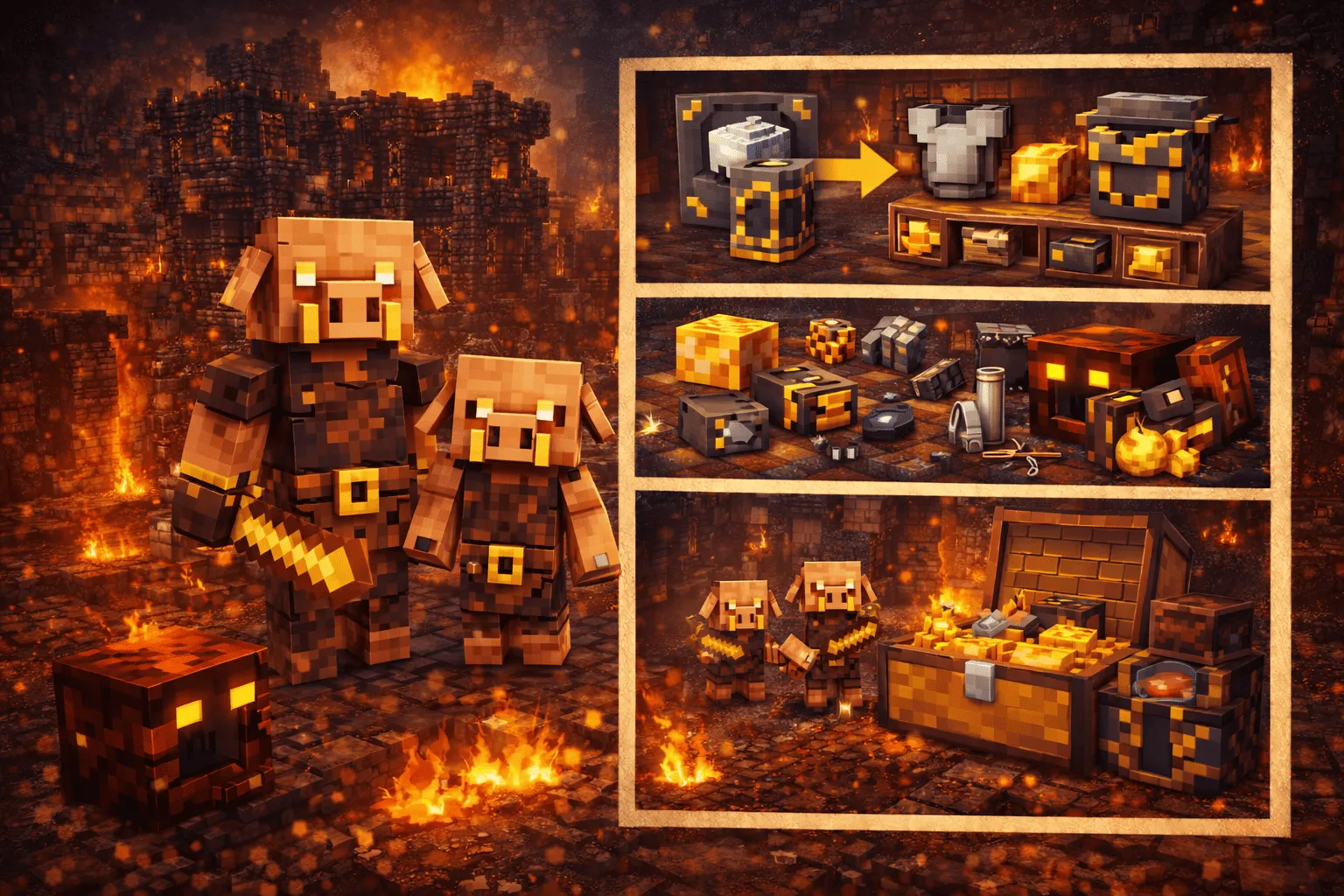
Minecraft Bastion: How to Find and Raid It
The Minecraft bastion (or bastion remnant in English) is one of the most dangerous and rewarding structures in the Nether. Introduced with the 1.16 update (Nether Update) in 2020, the Nether bastion is a massive ruined fortress built of blackstone and basalt, inhabited by piglins, piglin brutes, and sometimes hoglins. It is especially the only place in the game to find the netherite upgrade smithing template, essential for transforming your diamond equipment into netherite since version 1.20.
This guide explains how to find a Minecraft bastion, what types exist, what loot to collect, and how to survive the raid. Whether you're looking for your first Minecraft bastion or preparing for an optimized raid, here's everything you need to know.
What is a Bastion?
A bastion is a massive structure that naturally generates in the Nether. It consists of walls made of blackstone, polished blackstone, blackstone bricks, and basalt, forming towers, corridors, bridges, and treasure rooms. Each bastion is unique in its exact layout but follows one of four basic patterns (detailed below).
Bastions are the only natural generation sites for several exclusive items: gilded blackstone, the Pigstep music disc, the snout banner pattern, the snout armor trim, and especially the netherite upgrade smithing template. This exclusivity makes exploring bastions essential for progression to the netherite tier.
Upon generation, each bastion contains piglins (armed with gold swords or crossbows) and piglin brutes (always hostile, 50 health points, the most dangerous enemies in the structure). Normal piglins are only hostile if you don't have gold armor or if you open a chest in their presence. Piglin brutes attack on sight, regardless of what you're wearing.
How to Find a Bastion in the Nether
Bastions generate in all Nether biomes except basalt deltas. You can find them in Nether wastes, soul sand valleys, warped forests, and crimson forests.
The structure generation in the Nether follows a region system. The world is divided into zones of 432×432 blocks (Java) or 480×480 blocks (Bedrock), with a 4-chunk separation border between each zone. In each zone, only one major structure can generate: either a Nether fortress or a bastion, never both. If you find a fortress, move at least 400-500 blocks in another direction to encounter a potential bastion.
The fastest method to locate a bastion is to use the command /locate structure minecraft:bastion_remnant, which displays the coordinates of the nearest bastion. In survival mode without cheats, explore the Nether while staying in compatible biomes and look for large dark structures made of blackstone, recognizable by their imposing and angular architecture.
In practice, bastions are relatively frequent. With a Nether portal and a few minutes of exploration in the right direction, you will find one without major difficulty. The challenge is not finding it but getting out alive.
The 4 Types of Bastions
Each bastion corresponds to one of the following four types, determined randomly upon generation. Each type has distinct architecture and loot:
| Type | Architecture | Main Mobs | Notable Loot | Guaranteed Smithing Template? |
|---|---|---|---|---|
| Treasure Room | Square fortress with central chamber surrounded by lava, magma cube spawner | Piglin brutes (numerous), magma cubes | Netherite smithing template, netherite ingot, ancient debris, enchanted golden apple, enchanted diamond equipment | Yes (100%) |
| Bridge | Central bridge suspended over void or lava | Piglins, piglin brutes, hoglins | Netherite smithing template (~10%), snout armor trim, enchanted gold equipment | No |
| Housing Units | Four buildings around a central courtyard with Nether wart | Piglins (numerous), piglin brutes | Pigstep disc, snout banner, gilded blackstone, enchanted equipment | No |
| Hoglin Stables | Three-level structure with open pens | Hoglins (numerous), piglins | Ancient debris, netherite scrap, golden carrots, saddles | No |
The most sought-after type is the treasure room: it is the only one that guarantees the presence of a netherite smithing template in the treasure chest. The other three types may contain it in their generic chests, but with a probability of about 10% per chest only.
Bastion Loot (Smithing Template...)
The netherite smithing template is the most coveted item in bastions. Without it, you cannot convert your diamond equipment into netherite. To obtain a complete set of netherite armor and tools, you will need several templates (one per piece of equipment), unless you duplicate them. Duplication costs 7 diamonds and 1 netherrack per copy. For everything you need to know about this process, check out our complete Netherite guide.
Beyond the smithing template, bastions contain varied and valuable loot. In treasure chests, you can find netherite ingots, ancient debris, netherite scraps, crying obsidian, enchanted diamond equipment (swords, pickaxes, armor), enchanted golden apples (God Apples), the Pigstep music disc (exclusive to bastions), enchanted books (including treasure enchantments like Soul Speed), and gold blocks in quantity.
Generic chests, present in all types of bastions, contain less prestigious but useful loot: iron and gold ingots, spectral arrows, chains, blackstone, and enchanted gold equipment.
Strategy for Raiding a Bastion
Bastions are particularly hostile structures. Here is a methodical approach to maximize your loot and minimize risks.
Before entering, equip yourself with a full set of diamond or netherite armor with Protection IV, a sword with Sharpness V and Knockback II, a bow with Power V, and building blocks (cobblestones or blackstone). Wear at least one piece of gold armor (boots are the best choice) to avoid agitating normal piglins. Piglin brutes will ignore gold armor and attack regardless.
Upon entering the bastion, first identify the type of structure. If it's a treasure room, locate the central chamber (below, surrounded by lava). Eliminate piglin brutes first: they deal heavy damage (up to 19 damage points on hard) and do not despawn. Use a shield or bow to manage groups.
Never open a chest in front of a piglin: this triggers hostility from all nearby normal piglins (but not brutes, already hostile). Kill or move piglins away before looting chests. In the treasure room, the main chest is at the center of the platform surrounded by lava. Approach by building a bridge with blocks, and quickly destroy the magma cube spawner to avoid being overwhelmed.
For a multiplayer server, coordinating the raid with multiple players greatly facilitates the operation: one player distracts the brutes while others loot the chests. To enjoy these raids with friends, check out our Minecraft hosting offers with Anti-DDoS protection and optimized performance.
Bastion FAQ
Can you find two bastions close to each other?
No. The Nether generation system allows only one major structure (bastion or fortress) per zone of 432×432 blocks (Java) or 480×480 blocks (Bedrock). Two bastions will always be separated by at least 400 blocks.
Do piglin brutes respawn?
No. Piglin brutes are generated only when the bastion is created and never respawn. Once all are eliminated, the bastion is permanently secured (except for normal piglins, which can respawn).
Can you prevent piglins from becoming hostile when opening a chest?
No. Opening, breaking, or placing a chest in the presence of piglins always triggers their hostility, even with gold armor. The only solution is to eliminate or move all piglins away from the area before opening chests.
Is the netherite smithing template guaranteed in every bastion?
Only in treasure room bastions, where the treasure chest always contains one (100%). In the other three types, it can appear in generic chests with a probability of about 10% per chest.
What command to use to locate a bastion?
Type /locate structure minecraft:bastion_remnant in the chat (Java Edition, cheats enabled). On Bedrock, the command is /locate structure bastion_remnant. The coordinates of the nearest bastion will be displayed immediately.