
 Client area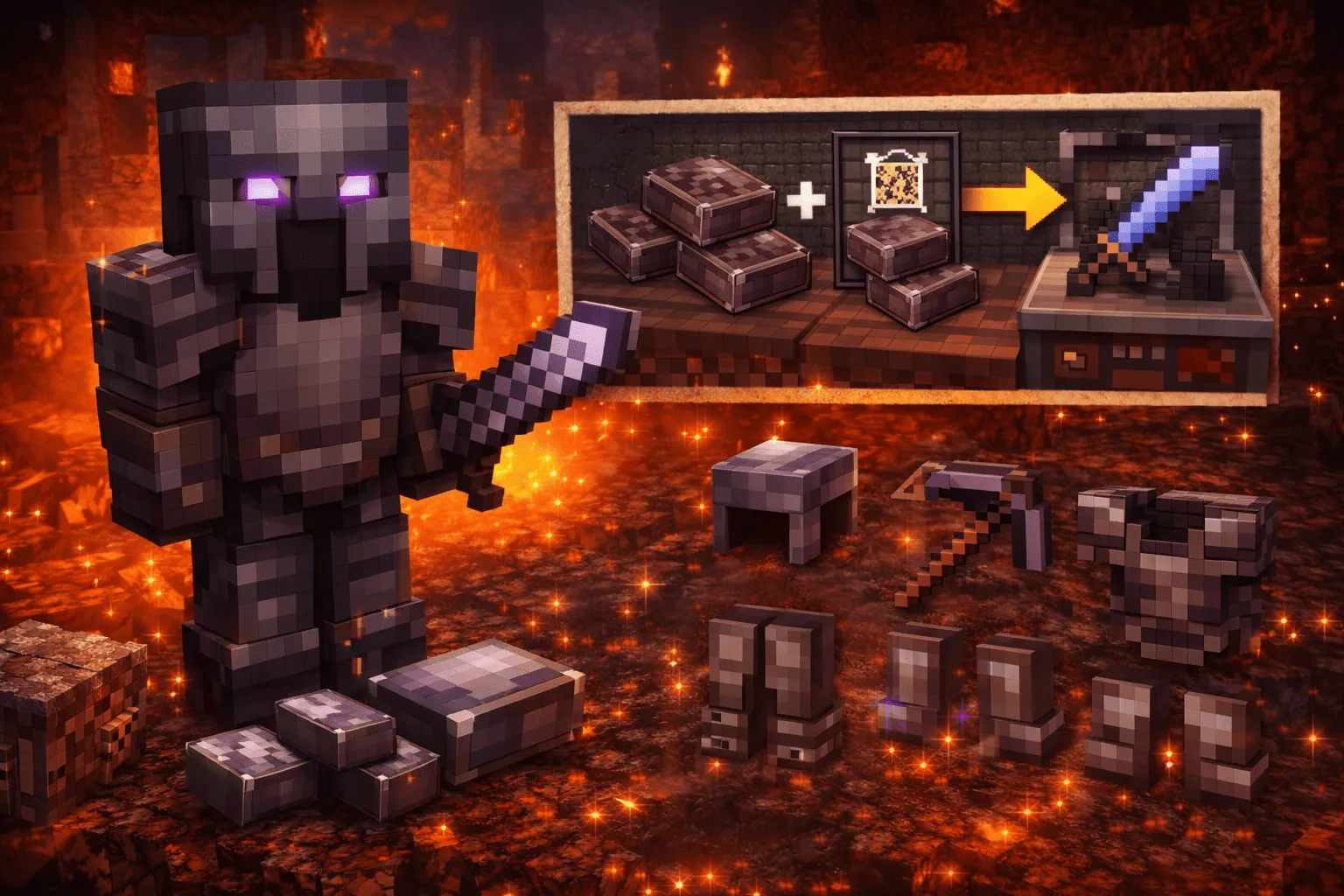
Netherite Minecraft: crafting, armor, and smithing template (Complete Guide)
Netherite is the most powerful material in Minecraft. Introduced in the 1.16 update (Nether Update), it surpasses diamond in durability, knockback resistance, and enchantment value. Netherite items also have a unique property: they do not burn in lava. Whether you're looking to craft your first netherite armor or understand the workings of the netherite smithing template added in 1.20, this guide covers the entire process, from finding ancient debris to full equipment.
In 2026, obtaining Minecraft netherite requires mastering three distinct steps: mining ancient debris in the Nether, transforming them into netherite ingots, and then using a smithing template on a smithing table to convert your diamond pieces. Here's everything you need to know.
Netherite is Minecraft's strongest material, crafted from ancient debris found in the Nether. It outperforms diamond in durability, does not burn in lava, and preserves enchantments on upgrade. Key facts:
- Where to mine: ancient debris at Y=15 in the Nether (optimal range: Y=8 to Y=22)
- Craft: 4 ancient debris → 4 netherite scraps; 4 scraps + 4 gold ingots → 1 netherite ingot
- Upgrade: 1 netherite ingot + netherite upgrade smithing template + diamond gear → smithing table
- Unique property: netherite items do not burn in lava
Where to find ancient debris
Ancient debris is the raw ore of netherite. They are found exclusively in the Nether, buried in netherrack, basalt, and blackstone. They are never exposed to air: you will always find them hidden under other blocks, making the search more demanding than for any other ore. The good news is that they are explosion-resistant and float in lava, so you won't accidentally lose them.
To mine ancient debris, a diamond pickaxe is the minimum requirement. No lower quality tool can harvest them.
Best level (Y) for mining
The generation of ancient debris follows a precise pattern. In each chunk (16×16 block area), the game places a vein of 1 to 4 blocks between layers Y=8 and Y=22, then an additional vein of 0 to 2 blocks between Y=8 and Y=119. The vast majority of debris is therefore concentrated in the Y=8 to Y=22 range, with a frequency peak around Y=15. This is the height where you should focus your mining.
To check your vertical position, press F3 on Java Edition (the Y coordinate is displayed in the debug information) or enable the coordinate display in the world settings on Bedrock Edition.
On average, you will find about 2 blocks of ancient debris per chunk, with a theoretical maximum of 5. For a single netherite ingot, you need 4 ancient debris. For complete equipment (helmet, chestplate, leggings, boots, sword, pickaxe), you need at least 24 ancient debris, which means about 12 fully explored chunks at the correct layer.
Bed and TNT mining technique
Classic gallery mining works, but two techniques are significantly faster and exploit the fact that ancient debris is explosion-resistant.
The bed method is the most accessible at the start of the game. In the Nether, beds explode when a player tries to sleep in them. This explosion destroys surrounding blocks within a radius of about 5 blocks but leaves ancient debris intact. The technique: dig a 1×1 tunnel at level Y=15, move forward 6 blocks, place a bed in front of you, and right-click to trigger the explosion. Protect yourself with a block between you and the bed to absorb the damage. Bring wood and wool separately (they take up less space than pre-crafted beds) and craft the beds on-site.
The TNT method is more effective but costs more resources. Dig a 2×1 tunnel at level Y=15, place a TNT block every 3 blocks, and light the chain. The chain reaction clears a radius of about 12 blocks. Prepare fire resistance potions and solid armor, as you may fall into lava pockets revealed by the explosions.
With these techniques, an experienced player can collect 20 to 30 ancient debris per hour.
How to craft a netherite ingot
Netherite crafting is broken down into two steps.
First, smelt your ancient debris in a furnace or blast furnace (the blast furnace smelts twice as fast). Each ancient debris gives a netherite scrap. Any fuel works: coal, wood, lava.
Second, combine 4 netherite scraps with 4 gold ingots in a crafting table. The arrangement is free (no imposed shape): simply place the 4 scraps and the 4 gold ingots anywhere on the 3×3 grid. The result is a netherite ingot.
Summary of the netherite crafting chain:
4 ancient debris → (furnace) → 4 netherite scraps + 4 gold ingots → (crafting table) → 1 netherite ingot
This ingot is then used on the smithing table, in combination with a smithing template and a diamond piece of equipment, to obtain the corresponding netherite item. The enchantments, remaining durability, and custom name of the diamond item are fully retained during the conversion.
The netherite smithing template
Since the 1.20 update (Trails & Tales), a smithing template is mandatory to convert diamond equipment to netherite. Before this version, it was enough to combine the diamond item and a netherite ingot directly. This is no longer the case: without the netherite smithing template, conversion is impossible.
The netherite upgrade template is consumed with each use. One template = one piece of equipment converted. For a complete set (4 pieces of armor + sword + pickaxe), you need 6 templates.
Where to find the smithing template (bastions)
The netherite smithing template is found exclusively in Nether bastion remnants. There are four types of bastions (bridge, housing unit, hoglin stables, treasure room), and all can contain the template in their chests, with about a 10% chance per chest.
The treasure room is the exception. This bastion variant features a large central platform surrounded by lava, covered with gold blocks, and guarded by piglin brutes. The chests on this platform contain a netherite smithing template guaranteed (100% chance).
Some tips for safely looting a bastion: wear at least one piece of gold armor (piglins ignore players wearing gold, but piglin brutes attack regardless). Before opening a chest, surround yourself with a temporary 2×2 block shelter, as opening a chest makes all nearby piglins hostile, even with gold. Bring solid blocks, food, and ideally a fire resistance potion. For a detailed guide on how to find a Minecraft bastion and loot it effectively, check out our dedicated article on find a Minecraft bastion.
How to duplicate the smithing template
The good news: once the first template is obtained, you can duplicate the netherite smithing template as many times as needed. The duplication recipe uses a crafting table with the following arrangement: the smithing template at the top center, a block of netherrack in the center of the grid, and 7 diamonds filling the remaining 7 slots.
The result: 2 netherite smithing templates (the original is retained + one copy). You can repeat the operation indefinitely, but the cost in diamonds is significant: 7 diamonds per duplication. For 6 templates (complete equipment), you need to find 1 original template + duplicate 5 times, totaling 35 diamonds.
This duplication recipe works the same way for all smithing templates in the game (including armor trims), but the central material changes depending on the template (netherrack for netherite, sandstone for dunes, stone for sentinel, etc.).
Netherite armor and tools
Netherite armor and tools are not crafted directly. The process is always an upgrade from diamond via the smithing table. Here is the complete procedure for each piece:
Place the smithing table (craft: 4 wooden planks + 2 iron ingots). Open its interface: three slots appear. Insert the netherite smithing template in the first slot (on the left). Place the diamond item in the second slot (in the center). Place a netherite ingot in the third slot (on the right). Retrieve the netherite item in the result slot.
All enchantments and the durability of the diamond item are retained. If your diamond pickaxe had Efficiency V, Fortune III, and Mending, the netherite pickaxe will keep them entirely.
Diamond vs Netherite compared statistics
Here is the detailed comparison between diamond and netherite for each type of item:
| Characteristic | Diamond | Netherite | Advantage |
|---|---|---|---|
| Sword durability | 1,561 | 2,031 | +30% |
| Pickaxe durability | 1,561 | 2,031 | +30% |
| Armor durability (chestplate) | 528 | 592 | +12% |
| Sword damage | 7 | 8 | +1 damage |
| Pickaxe damage | 5 | 6 | +1 damage |
| Armor protection (total set) | 20 | 20 | Identical |
| Armor knockback resistance | 0 | 10 (full set) | Exclusive netherite |
| Resistant to lava/fire | No | Yes | Exclusive netherite |
| Enchantment value | 10 | 15 | +50% |
| Pickaxe mining speed | 8 | 9 | +12.5% |
Netherite offers the same total protection points as diamond (20 points for a full set) but adds knockback resistance that reduces the knockback taken from attacks. This is a major advantage in PvP and against powerful mobs like the Warden or the Wither.
The higher enchantment value means that netherite items have a better chance of obtaining high-level enchantments via the enchantment table, although the difference remains modest in practice.
The true unique asset of netherite is its immunity to fire and lava. If you die in the Nether above a lava lake, your netherite equipment will float on the surface instead of burning. It's an irreplaceable insurance for Nether exploration and battles against the Wither.
On a multiplayer server, netherite equipment makes a significant difference in PvP thanks to the knockback resistance and the extra damage point per hit. If you're looking for a high-performance server to fully enjoy Minecraft multiplayer, check out our Minecraft hosting offers with high-frequency processors and included Anti-DDoS protection.
Netherite FAQ
How many ancient debris for a full netherite set?
A full set of armor (helmet, chestplate, leggings, boots) requires 4 netherite ingots, which means 16 ancient debris and 16 gold ingots. If you add the sword and pickaxe, count 24 ancient debris and 24 gold ingots in total.
Can netherite be destroyed?
Netherite items do not burn in lava or fire, but they can be destroyed by the void (falling below the world) or by the explosion of a bed anchored in the End. The netherite block itself can also be destroyed by a Wither explosion, as the explosion resistance of dropped items and that of placed blocks are two distinct mechanics. Note: the netherite smithing template, unlike ingots and equipment, burns in lava.
Can you get netherite without going to the Nether?
No. Ancient debris generates exclusively in the Nether and cannot be obtained in any other way in survival. The netherite smithing template is found only in Nether bastions. Both essential components therefore require a trip to the Nether.
What is the difference between the netherite smithing template and ornament templates?
The netherite smithing template (Netherite Upgrade) is the only functional template: it converts a diamond item to netherite with a bonus in statistics. The other 16 smithing templates are purely cosmetic ornaments that add decorative patterns to armor pieces without modifying their statistics.
Should you enchant before or after converting to netherite?
Both work, as enchantments are retained during conversion. However, it is generally advised to enchant in diamond first, as this allows you to test and adjust your enchantments (via an anvil or enchanted book) on a less rare material. Once satisfied with your enchantments, convert to netherite. To know which armor enchantments to choose and combine effectively, check out our dedicated guide on armor enchantments.
Is netherite useful on a modded server?
On a modded server, some modpacks add materials even more powerful than netherite (allthemodium in ATM10, for example). But netherite remains an essential progression tier in the vast majority of modpacks. The fire resistance and superior durability make it relevant even in the presence of higher-level materials.