
 Client area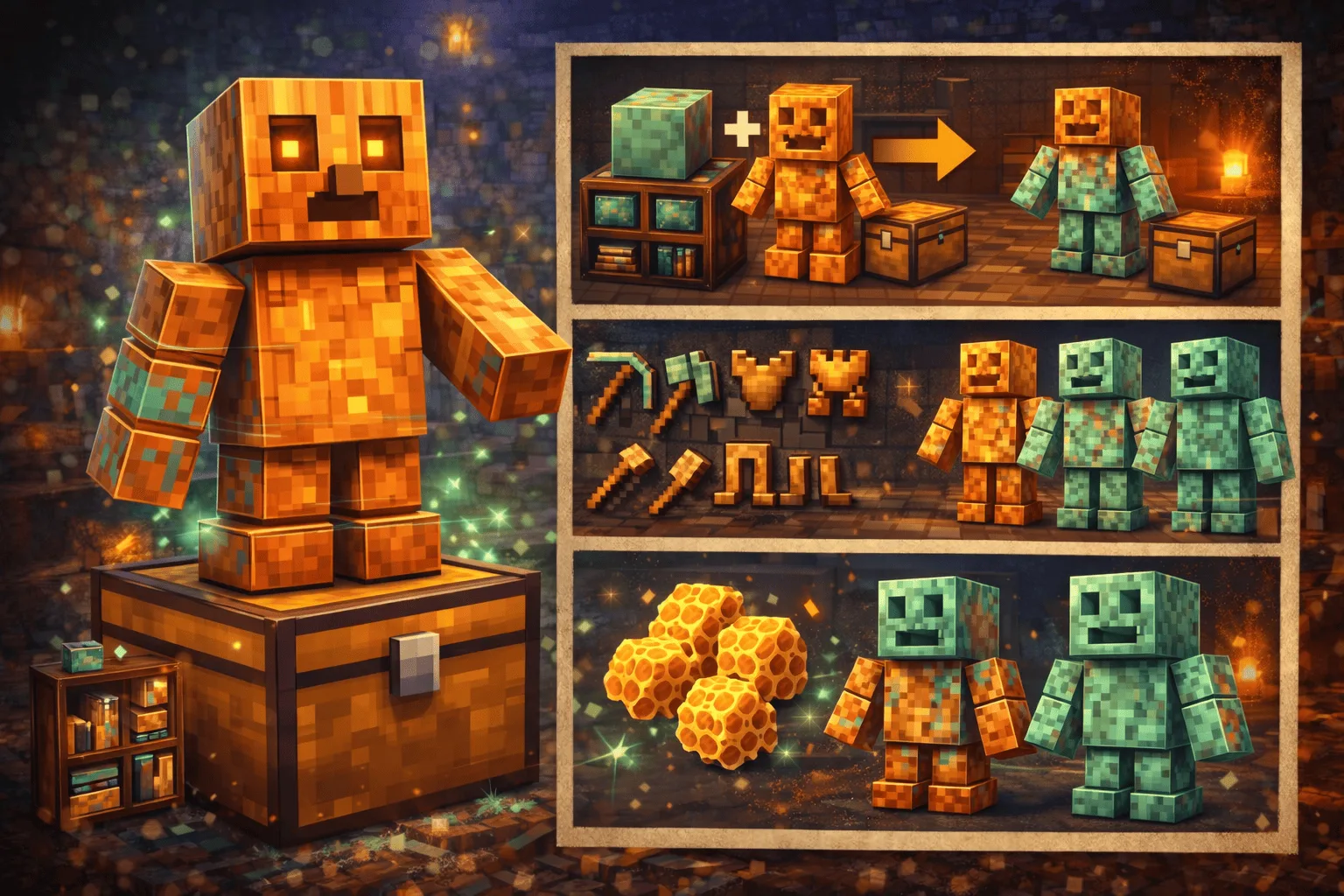
Copper Golem Minecraft: Complete Guide
The copper golem is one of the most anticipated additions to Minecraft. Initially proposed during the Minecraft Live 2021 mob vote (where it lost to the Allay), it was finally integrated into the game with The Copper Age update, released on September 30, 2025, on Java Edition (1.21.9) and Bedrock Edition (1.21.110). This small mechanical companion automatically sorts your items, oxidizes over time, and can even transform into a decorative statue with redstone applications.
This guide covers everything you need to know about the Minecraft copper golem: its crafting, behavior, oxidation system, copper chests, and the new shelves introduced in the same update.
Copper in Minecraft: All Uses
Before The Copper Age, Minecraft copper was an abundant but underutilized ore. It was mainly used to craft lightning rods, spyglasses, and decorative blocks that oxidized over time. Since the update, copper has become a full-fledged progression tier, with a complete crafting tree.
Here are all the uses of copper in Minecraft in 2026: complete equipment (sword, pickaxe, axe, shovel, hoe in copper), complete armor (helmet, chestplate, leggings, boots in copper), horse armor in copper, copper chest, copper golem, decorative blocks (blocks, slabs, stairs, pillars), lighting (copper torches, copper lanterns), copper chains and bars, and the already existing lightning rod.
Copper equipment is between stone and iron in terms of durability and mining speed. It does not oxidize (unlike blocks and the golem). For early-game players, it's an interesting intermediate tier: copper is easier to find than iron and offers better performance than stone. Hostile mobs can also appear equipped with copper armor and pick up copper weapons from the ground.
How to Craft the Copper Golem
The copper golem is not crafted on a classic crafting table. It is built directly in the world, in the same way as the iron golem or the snowman.
The recipe is simple: place a copper block on the ground (any type: normal, exposed, weathered, oxidized, waxed or not), then place a carved pumpkin or a jack-o'-lantern on top. The copper golem appears immediately, accompanied by a copper chest that generates nearby.
Some important details: the pumpkin must be placed last (after the copper block). The copper block is consumed during the summoning. The golem can also be summoned via a spawn egg in creative mode or with the /summon command. When killed, it drops 1 to 3 copper ingots.
The copper chest that appears with the first golem is the only way to initially obtain one. Once this first chest is acquired, the recipe unlocks: a classic chest surrounded by 8 copper ingots on the crafting table. You can then craft as many as needed to expand your sorting system.
Functionality and Behavior
The copper golem is a passive mob created by the player. Its main function is automatic item sorting. It moves freely within a radius of 32 blocks horizontally and 8 blocks vertically around its activity area.
Its operating cycle is as follows: it takes items deposited in a copper chest, then searches for a nearby classic chest already containing the same type of item. If it finds one, it deposits the items there. A golem can carry up to 16 items (one stack) per trip. If no corresponding chest is found, the golem keeps the items or puts them back in the copper chest.
It's a semi-automatic sorting system. Unlike hopper and redstone sorting systems (complex and resource-intensive), the copper golem offers a simple and visual solution. It is particularly suited for medium-sized bases where hopper sorting would be excessive.
The copper golem interacts exclusively with classic chests, trapped chests, and copper chests. It cannot interact with barrels, shulker boxes, or hoppers. It is also limited by its size: chests placed at height or in too narrow spaces are inaccessible to it.
Multiple golems can work simultaneously in the same area and share the same chests. This allows parallel sorting for bases with a large storage volume.
Interaction with Iron Golems
The update added a special interaction between the copper golem and the iron golem. When they meet, the iron golem exhibits a protective behavior towards the small copper golem, a purely visual but particularly charming interaction.
Oxidation and Waxing
Like all copper elements in Minecraft, the copper golem oxidizes gradually over time. It goes through four visual stages: unoxidized (bright orange), exposed (orange-green), weathered (verdigris), then fully oxidized (turquoise). When it reaches the final stage, the golem freezes and transforms into a copper golem statue block.
This statue is a decorative block in its own right. It can adopt one of four different poses, which you can change by interacting with the block. Each pose emits a distinct redstone signal when connected to a comparator, opening up creative possibilities: combination locks, secret doors, selection systems.
To prevent oxidation, apply honeycomb to the golem: this waxes it and locks oxidation at the current stage. A waxed golem retains its appearance and remains functional indefinitely.
To reverse oxidation, use an axe on the golem or statue: each click removes one stage of oxidation. A fully scraped statue becomes an active copper golem again. Lightning can also remove oxidation, as with classic copper blocks.
Decor tip: you can intentionally let your golems oxidize to obtain statues at different patina stages, then wax them to freeze them. Combined with the four poses, this gives 16 visual variants of statues for your constructions.
Copper Shelves
The Copper Age update also introduced shelves, a new storage and display block. Although the name "Minecraft shelf" is often associated with copper in searches, the shelves are not made of copper but wood. However, they are part of the same storage ecosystem as the golem and the copper chest.
The shelf recipe is simple: 6 stripped logs of the same type of wood, placed in two horizontal rows (top row and bottom row) on the crafting table. This produces 6 shelves. All types of wood are compatible (oak, spruce, birch, acacia, etc.), including Nether woods (crimson, warped) and bamboo. However, you cannot mix wood types in the same recipe.
Each shelf displays up to 3 items on its front face, similar to a frame but more practical. To place an item, hold it in your main hand and interact with the shelf. If a slot is already occupied, the item is exchanged with the one in your hand.
The redstone functionality of shelves is particularly interesting. When a shelf is powered by redstone (via a lever or redstone dust), it enters "quick exchange" mode: interacting with it automatically exchanges the items in your hotbar. A powered shelf exchanges the 3 rightmost slots of your hotbar. Two connected shelves exchange 6 slots. Three connected shelves exchange all 9 slots, i.e., your entire hotbar.
This mechanism is ideal for creating quick equipment change stations: one shelf with your mining kit, another with your combat kit, a third with your construction kit. One click is enough to swap everything.
Combined with copper golems for sorting and copper chests as entry points, the whole forms a storage and organization system much more accessible than traditional hopper factories. On a multiplayer server, this system also consumes much less TPS (ticks per second) than hoppers, improving overall performance. If you want to enjoy these new mechanics with your friends, you can create a Minecraft server in a few minutes, or check out our Minecraft hosting offers for a high-performance server with Anti-DDoS protection included.
Copper Golem FAQ
How to prevent a copper golem from oxidizing?
Apply honeycomb directly to the golem by right-clicking. This waxes it and stops oxidation at the current stage. You can wax a golem at any stage: unoxidized, exposed, weathered, or fully oxidized.
Does the copper golem attack hostile mobs?
No. Unlike the iron golem, the copper golem is a passive utility mob. It never fights and focuses exclusively on item sorting. It does not take fall damage but can be killed by other damage sources.
How many chests can a copper golem manage?
A single golem can interact with all classic, trapped, and copper chests within a radius of 32 horizontal blocks and 8 vertical blocks. There is no limit to the number of chests, but a single golem processes one stack (16 items max) per trip. For a base with a lot of storage, multiple golems in parallel significantly speed up sorting.
Can you awaken a copper golem statue?
Yes. Scrape the statue with an axe to remove the oxidation layers one by one. Once back to the unoxidized stage, the statue becomes an active golem again. Lightning has the same effect.
Does the copper golem work on Bedrock and Java?
Yes, The Copper Age update is available on both editions since September 30, 2025 (Java 1.21.9, Bedrock 1.21.110). The golem's behavior is identical on both versions.
Do copper armor and tools oxidize?
No. Only copper blocks, the copper chest, chains, bars, lanterns, and the copper golem oxidize. Copper armor and tools retain their appearance indefinitely.
What is the difference between the copper golem and a hopper sorting system?
The golem is simpler to set up (no redstone, no hoppers, no circuits) and consumes fewer server resources. However, it is slower and less precise than a well-designed hopper system. The golem is ideal for personal bases and multiplayer servers concerned with performance, while hoppers remain preferable for high-throughput automated farms.