
 Client area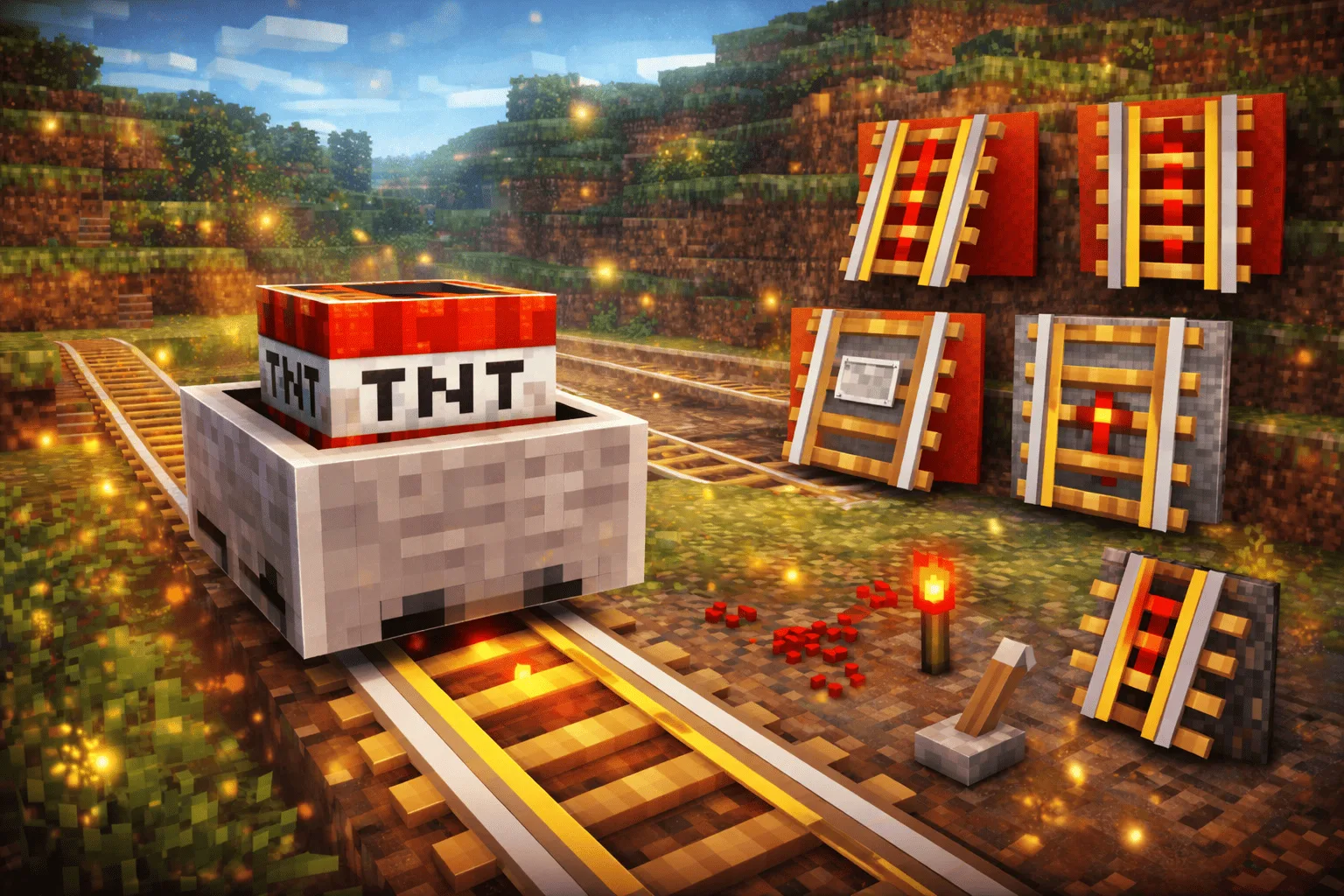
Rails Minecraft: crafting, types, and minecart circuits
Minecraft rails have been a fundamental element of the game since its early versions. They allow players to create minecart transportation systems for players, items, and even TNT. Whether you're building a simple line between two bases or a complex automated transport network, mastering the four types of Minecraft rails is essential.
This guide covers the crafting of each rail variant, their respective functions, and techniques for building efficient minecart circuits in 2026. Each Minecraft rail has a specific role in the transport chain, and combining them correctly makes all the difference.
The 4 types of rails
Minecraft offers four types of rails, each with a specific function. Here's a comparative overview:
| Rail Type | Crafting Materials | Quantity Produced | Main Function |
|---|---|---|---|
| Standard Rail | 6 iron ingots + 1 stick | 16 rails | Basic transport, turns, slopes |
| Powered Rail | 6 gold ingots + 1 stick + 1 redstone | 6 rails | Accelerates or slows down the minecart |
| Detector Rail | 6 iron ingots + 1 stone pressure plate + 1 redstone | 6 rails | Emits a redstone signal when passed over |
| Activator Rail | 6 iron ingots + 2 sticks + 1 redstone torch | 6 rails | Ejects passengers, activates TNT, locks hoppers |
The standard rail is the only one that generates naturally in abandoned mines. The other three must be crafted. You can also collect rails from abandoned mines by breaking them (a pickaxe speeds up mining, but they can be broken by hand).
How to craft each type of rail
The crafting of Minecraft rails follows a similar pattern for all four types: two columns of the main material on the sides, and a central component. Here are the detailed recipes.
The standard rail uses 6 iron ingots distributed in the left and right columns of the 3×3 grid (3 per column), with 1 stick in the center. It's the most cost-effective recipe: it produces 16 rails at once. For a 100-block line, you only need 38 iron ingots and 7 sticks, which is very accessible even at the start of the game.
The powered rail replaces iron with gold: 6 gold ingots in the side columns, 1 stick in the center, and 1 redstone dust at the bottom center. It produces 6 rails. The cost in gold makes this rail more valuable, but it is essential for maintaining the speed of minecarts. Without powered rails, a minecart gradually slows down and eventually stops.
The detector rail crafting uses 6 iron ingots in side columns, 1 stone pressure plate in the center, and 1 redstone dust at the bottom center. It produces 6 rails. This rail functions like an integrated pressure plate: it emits a redstone signal of power 15 when a minecart passes over it.
The activator rail combines 6 iron ingots in side columns, 2 sticks (one in the center, one at the bottom center), and 1 redstone torch in the middle. It produces 6 rails. This specialized rail ejects players and mobs from standard minecarts, primes TNT minecarts (explosion after 4 seconds), and locks or unlocks hopper minecarts.
Building a minecart circuit
A functional minecart circuit relies on alternating between standard rails and powered rails. Here are the fundamental principles for building a reliable network.
On flat terrain, a powered rail powered by redstone propels an occupied minecart for about 80 blocks before the speed drops significantly. In practice, placing a powered rail every 8 to 12 blocks ensures a constant maximum speed (8 m/s). For optimal cost-effectiveness, a powered rail every 25-30 blocks is sufficient to maintain regular movement, even if the speed fluctuates slightly.
Uphill, the minecart loses speed quickly. For slopes, place a powered rail every 2 to 3 blocks to counteract gravity. Downhill, standard rails suffice as gravity naturally accelerates the minecart.
To power the powered rails, place a redstone torch under or next to the rail, a lever directly on an adjacent block, or a redstone block under the rail. The simplest and most economical method is the redstone torch placed next to the rail, which activates up to 9 consecutive powered rails in the same direction.
A basic transport circuit between two points consists of: a departure station (a powered rail powered with a button to launch the minecart), a line of standard rails with regularly spaced powered rails, and an arrival station (an unpowered powered rail that slows the minecart, followed by a solid block to stop it).
For two-way systems, use detector rails at stations to detect the arrival of a minecart and automatically activate the departure powered rails. This creates an automated circuit where the minecart makes round trips without player intervention.
For item transport, combine a hopper minecart with detector rails. The hopper minecart collects items on the ground as it passes and deposits them in a chest connected via a hopper at the arrival station. This system is widely used for automated farms: the minecart circulates in a loop under the farm, collects drops, and centralizes them in a storage point.
Advanced tips (redstone + rails)
Detector rails are the key to automated systems. When a minecart passes over a detector rail, it emits a redstone signal of power 15 for a brief moment. This signal can activate doors, pistons, lamps, dispensers, or other powered rails. By placing a detector rail just before a powered rail, the minecart activates its own acceleration, eliminating the need for permanent redstone torches.
For stations with multiple destinations, combine detector rails with switches. A switch is created by placing a rail at a T-intersection: depending on the direction of the received redstone signal, the rail turns left or right. A lever or selection circuit allows the player to choose their destination before boarding the minecart.
Rails in the Nether are an essential travel trick. Since 1 block in the Nether equals 8 blocks in the Overworld, a 125-block minecart line in the Nether covers 1,000 blocks in the normal world. It's the most efficient long-distance transport method in the game, especially useful on multiplayer servers where bases are far apart.
For more complex redstone circuits using prolonged or delayed signals, a redstone repeater allows precise control of activation timing.
On a multiplayer server, large-scale rail systems can impact performance. Powered rails powered by redstone torches are lighter on TPS than complex redstone circuits. For an optimized server capable of handling these networks, check out our Minecraft hosting offers with high-frequency processors suited for intensive redstone builds.
Rails FAQ
How many iron ingots are needed for 100 standard rails?
The recipe produces 16 rails for 6 iron ingots and 1 stick. For 100 rails, you need 7 crafts (112 rails), which means 42 iron ingots and 7 sticks. It's relatively economical compared to powered rails that require gold.
Do rails work underwater?
Yes. Standard and special rails can be placed underwater. Minecarts move normally on submerged rails. However, powered rails require a redstone power source, and redstone dust does not work in water. Use redstone torches or redstone blocks to power underwater powered rails.
What is the maximum speed of a minecart?
A minecart reaches a maximum speed of 8 blocks per second (8 m/s) on flat terrain with powered rails powered. This speed is the same for all types of minecarts (passenger, chest, hopper, TNT).
Can you find rails without crafting them?
Yes. Standard rails are naturally found in abandoned mines, sometimes in large quantities. Powered and detector rails also appear there, but more rarely. You can also obtain powered rails by trading with villagers (no specific profession sells them directly, but some structure chests contain them).
How to prevent a minecart from falling off the end of the line?
Place a solid block (stone, dirt, etc.) at the end of the rail line. The minecart stops when hitting the block. For a smoother stop, place an unpowered powered rail just before the block: it gradually slows the minecart instead of stopping it abruptly.