
 Client area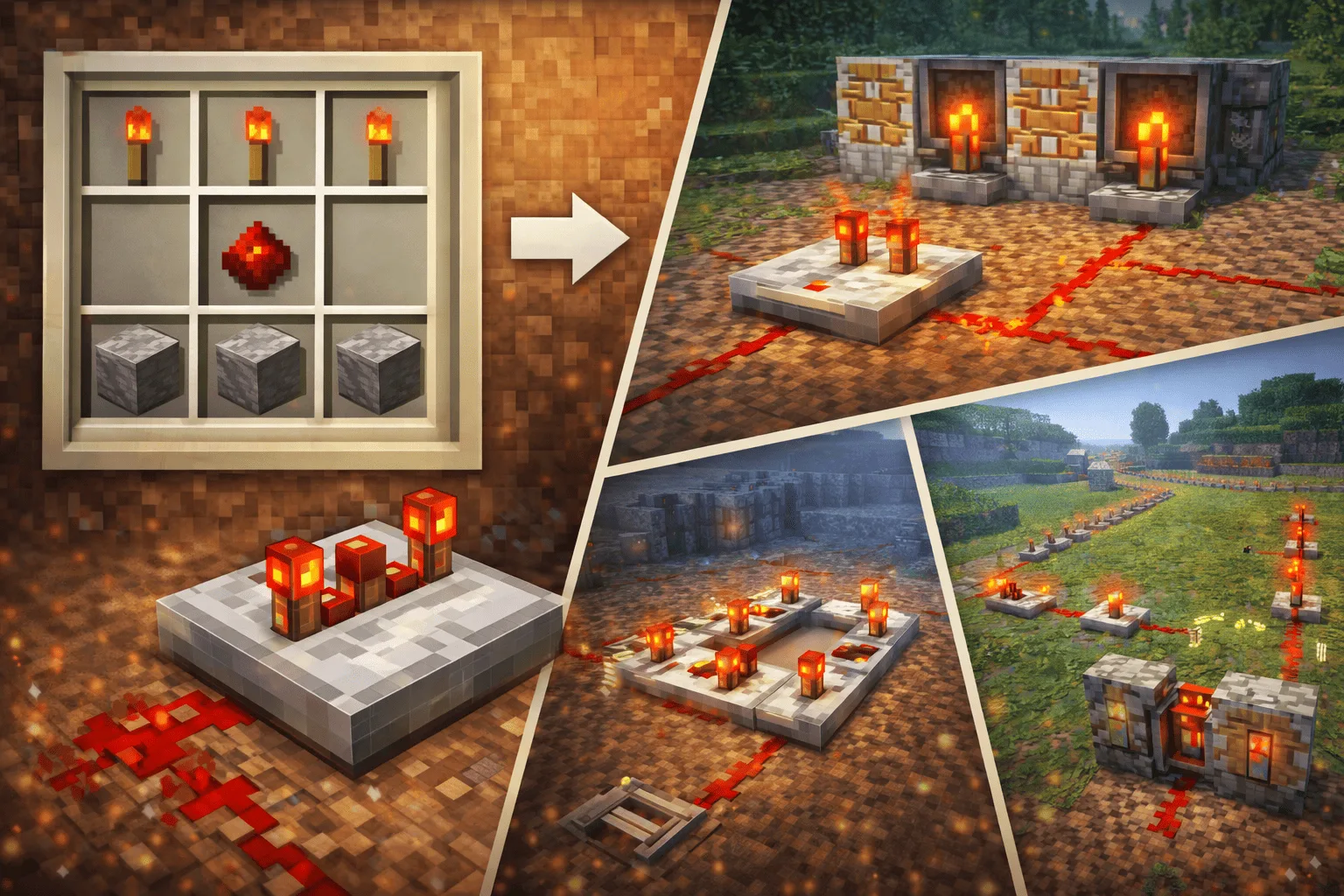
Minecraft Redstone Repeater: Crafting and Uses
The redstone repeater is one of the most useful components of the redstone system in Minecraft. It fulfills three essential functions: extending a signal beyond its 15-block range, introducing an adjustable delay, and acting as a one-way diode. Whether you're building a piston door, an automatic clock, or a Minecraft rail system, the Minecraft repeater is an indispensable tool in 2026.
This guide covers the crafting of the repeater, its detailed operation (delay, direction, locking), and concrete examples of circuits.
Crafting the Repeater
The repeater craft requires three common materials, all available from the start of the game.
The recipe is arranged on a 3x3 crafting table as follows: 3 stone blocks (Stone, not Cobblestone) on the bottom row, 1 redstone dust in the center of the middle row, and 2 redstone torches on the left and right of the dust. The result is 1 redstone repeater.
Beware of a common mistake: the recipe requires smooth stone (Stone), obtained by smelting Cobblestone in a furnace. Raw Cobblestone does not work.
For the redstone torches, simply combine 1 stick + 1 redstone dust on the crafting grid. Redstone dust is obtained by mining redstone ore (layers -64 to 15) with an iron pickaxe or better.
The repeater can also be found naturally in certain generated structures: jungle temples contain trap circuits that use them.
Operation (delay, direction, locking)
The redstone repeater has three fundamental properties that make it a central component of any complex circuit.
The first property is signal renewal. A redstone signal loses 1 power level per block traveled and extinguishes after 15 blocks. The Minecraft repeater receives this weakened signal and re-emits it at full power (level 15), allowing a signal to be transported over theoretically unlimited distances by chaining multiple repeaters.
The second property is the adjustable delay. Each repeater adds a minimum delay of 1 redstone tick (0.1 second). By right-clicking on the repeater, the delay gradually increases: 1 tick (0.1 s), 2 ticks (0.2 s), 3 ticks (0.3 s), then 4 ticks (0.4 s), before returning to 1 tick. The position of the small movable torch on the repeater visually indicates the selected delay. To achieve longer delays, simply chain multiple repeaters: for example, two repeaters set to 4 ticks give a total delay of 0.8 seconds. A repeater set to 2, 3, or 4 ticks also extends short pulses to match the duration of the delay, which is useful for stabilizing erratic signals.
The third property is the one-way direction (diode). The signal enters from the back of the repeater and exits from the front. It can never flow in reverse. This feature allows isolating circuit portions and avoiding undesirable feedback loops. Visually, the fixed torch indicates the input and the movable torch indicates the output.
In addition to these three properties, the repeater has an advanced function: locking. If a powered repeater or comparator is oriented towards the side of another repeater, the latter locks in its current state (on or off). A small bedrock bar pattern appears on the locked repeater. As long as the lock is active, the repeater ignores any changes to its input. This mechanic is the basis of memory circuits (RS memories, registers) and information storage systems in redstone.
Examples of Circuits with Repeaters
Here are three practical circuits that exploit the properties of the repeater.
The first example is the repeater clock. It is the most popular redstone circuit. Connect two repeaters in a loop with redstone dust, then introduce a one-tick pulse (by quickly placing and breaking a redstone torch next to the circuit). The signal circulates indefinitely in the loop. By adding repeaters and adjusting their delays, you control the clock's frequency. Two repeaters at 4 ticks each create a 0.8-second clock, ideal for automatic farms or burst dispensers.
The second example is the long-distance signal line. To connect your base to a distant structure (an outpost, a farm, a transport network), place a repeater every 15 blocks along your redstone line. Each repeater regenerates the signal at full power. Orientation is crucial: ensure that the fixed torch (input) points towards the source and the movable torch (output) towards the destination.
The third example is the sequenced piston door. For a 2x2 or 3x3 piston door to open cleanly, the pistons must activate in a specific order. Place repeaters with increasing delays (1 tick, 2 ticks, 3 ticks) on each branch leading to a piston. The result is a smooth opening sequence where each piston retracts with a slight offset, avoiding blocks getting stuck.
To test and develop complex redstone circuits on a multiplayer server without lag, a Minecraft hosting with high-frequency processors ensures stable TPS even with many active redstone components.
Repeater FAQ
What is the difference between a repeater and a comparator?
The repeater renews the signal at full power and adds a fixed delay. The comparator, on the other hand, compares or subtracts signal levels and can read the contents of certain blocks (chests, cauldrons, etc.). Both are complementary: the repeater manages timing and range, the comparator manages logic and measurement.
Can a repeater be placed on any block?
The repeater can only be placed on the top face of a full opaque block. It cannot be placed on glass, lower slabs, air, or on the sides/underside of a block.
Why doesn't my circuit work with Cobblestone?
The recipe requires smooth stone (Stone), obtained by smelting Cobblestone in a furnace. It's the most common crafting mistake. Double-check your materials.
How many repeaters are needed for 100 blocks of distance?
A redstone signal travels 15 blocks before extinguishing. For 100 blocks, at least 7 repeaters are needed (one every 15 blocks approximately). Each adds at least 1 tick of delay (0.1 s), resulting in a total minimum delay of 0.7 seconds to cover the full distance.
Does the repeater work underwater?
Yes. Redstone repeaters function normally when submerged (water blocks), allowing for underwater circuit construction. Redstone dust, however, is destroyed by water.