
 Client area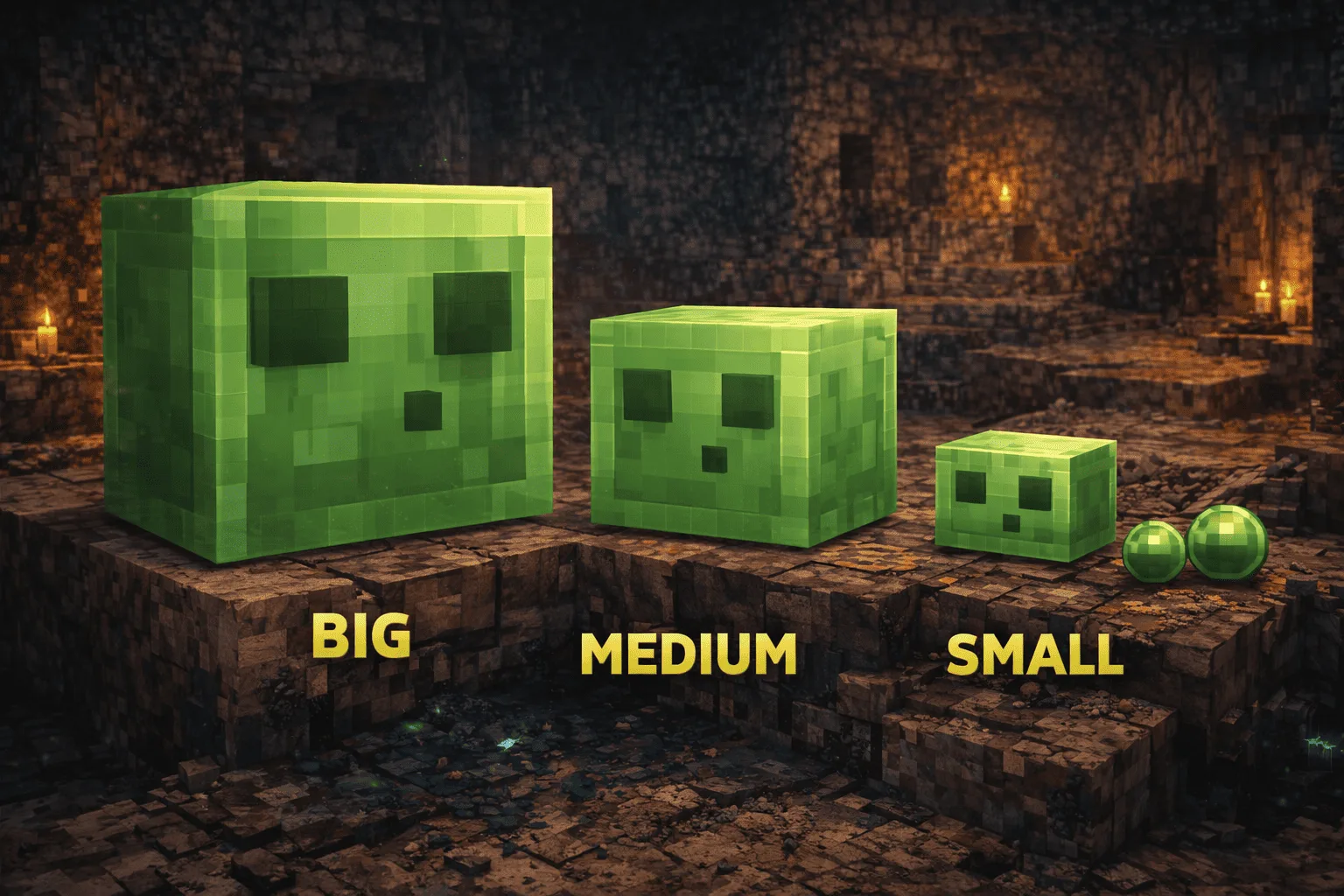
Slimes are among the most useful mobs in Minecraft, but also among the most elusive to find. Between strict spawning conditions, the concept of slime chunks, and building an efficient farm, there's a lot to understand before filling your chests with Slimeballs. This comprehensive 2026 guide covers everything you need to know about Slimes, from their behavior to building a farm with maximum yield.
All About Slime in Minecraft
The Slime is a hostile green mob that stands out from other enemies with a unique behavior: when killed, it splits into several smaller versions. This cascading mechanic is the basis of any good farming strategy.
The 3 Sizes of Slimes
Slimes come in three distinct sizes, each with its own characteristics:
| Size | Health Points | Damage | Drop on Death |
|---|---|---|---|
| Big | 16 HP | 4 damage | Splits into 2 to 4 Medium Slimes |
| Medium | 4 HP | 2 damage | Splits into 2 to 4 Small Slimes |
| Small/Tiny | 1 HP | 0 damage | Drops 0 to 2 Slimeballs |
Only Small Slimes drop Slimeballs. To maximize farm yield, ensure that Big and Medium Slimes die in conditions that allow complete division down to the Small stage.
Drops: Slimeballs and Their Uses
The main drop from Slimes is the Slimeball. Each Small Slime can drop up to 2, and the Looting III enchantment on your sword increases this amount. Slimeballs are essential for several key game recipes, detailed later in this guide.

Where Do Slimes Spawn?
Slimes have very particular spawning conditions compared to other mobs. They can only appear in three specific contexts.
In Swamps at Night
In the Swamp and Mangrove Swamp biomes, Medium and Big Slimes can spawn on the surface between Y=50 and Y=70, only at night and only when the moon phase is favorable. This method is the most accessible early in the game but offers random yield.
The conditions to meet in a swamp for optimal spawn are: being in Survival or Adventure mode, being within 128 blocks of the spawn area, and the moon phase being at least at the quarter (see FAQ at the end of the article for moon phase details).
In Slime Chunks (Y=0 to Y=40)
This is the most reliable and profitable method. Certain chunks (16x16 block columns) of the world are designated as "slime chunks" based on your world's seed. In these specific chunks, Slimes can spawn underground between Y=0 and Y=40, in any dark space with a minimum height of 3 blocks, and without light or moon phase conditions.
To fully understand how chunks work and their in-game boundaries, check out our complete guide on Minecraft chunks.
In Abandoned Mines (Rare)
Slimes can also spawn in Abandoned Mines (Mineshafts), but only in chunks identified as slime chunks. This spawn is anecdotal and does not constitute a reliable source of Slimeballs.
How to Find Slime Chunks
Identifying the slime chunks in your world is the key step to building a profitable underground farm.
Using Chunkbase or the Map Seed
The fastest way is to use the online tool Chunkbase (chunkbase.com), which generates a map of all slime chunks from your seed. To know your seed, type /seed in the in-game chat (works in single-player, in multiplayer only if you are op or if the server allows it).
On Chunkbase, select "Slime Chunks", enter your seed and version, and the map will display all active slime chunks in green. Find one close to your base to minimize travel time.
Visually Identifying Active Chunks
Without an external tool, it's possible to empirically identify slime chunks by digging underground rooms at Y=20 in different chunks and waiting. If Slimes appear, the chunk is active. This is a long method but does not require knowing your seed.
F3 + G Method to Visualize Chunks
The F3 + G combination displays chunk borders directly in-game as yellow lines. This allows you to precisely delimit the 16x16 blocks of each chunk and dig your farm exactly within the right limits. For a reminder on reading F3 coordinates, our guide on Minecraft coordinates explains the debug screen in detail.

How to Build a Slime Farm
There are two main approaches to farming Slimes: on the surface in a swamp or underground in a slime chunk. The choice depends on your progression stage and the desired amount of Slimeballs.
Surface Slime Farm (Swamp): Easy Construction
The surface farm is the simplest to build but the least productive. The principle is to create an elevated spawning platform in a swamp, then channel the Slimes to a kill zone.
Basic steps:
- Identify a swamp and locate an area between Y=50 and Y=70
- Build a flat platform of wood or stone at least 16x16 blocks
- Surround the platform with blocks to prevent Slimes from falling out of the area
- Dig a central pit 2 blocks deep where Slimes will fall and die
- Place lanterns or torches under the platform to prevent unwanted spawns below
Estimated Yield: 20 to 50 Slimeballs per hour depending on the moon phase.
Underground Slime Farm (Slime Chunk): Maximum Yield
This is the reference method for massive production. It exploits the permanent spawn in a slime chunk without moon phase dependency.
Construction steps:
- Locate a slime chunk via Chunkbase
- Dig a room at Y=20 of 16x16 blocks and 3 blocks high
- Replicate this room on multiple levels (Y=20, Y=14, Y=8) to multiply spawning surfaces
- Use flowing water to push Slimes to a central pit
- At the bottom of the pit, dig a kill zone and place a hoe or sword enchanted with Looting III
- Optional: add an automatic Slimeball collector with hoppers and chests
Estimated Yield: 100 to 300 Slimeballs per hour depending on the number of levels.
Optimization: Lighting, Ceiling Height
Some optimization rules to follow to maximize your farm's yield:
Lighting: Slimes spawn in darkness. The inside of the spawn room must remain at light level 0. Do not place torches inside. Only light your access corridor and the kill zone.
Ceiling Height: A height of 3 blocks is the minimum. Big Slimes need 3 blocks to spawn. If your room is only 2 blocks high, only Small and Medium Slimes can appear, significantly reducing yield.
Player Distance: Mobs only spawn within a 128-block radius around the player. Stay close to your farm during farming sessions, ideally in an AFK chamber at least 24 blocks from the spawn rooms (below 24 blocks, mobs do not spawn either).
Eliminating Unwanted Spawns: Light all caves within a 128-block radius around your farm. Each mob spawned elsewhere "takes the place" of a potential Slime in the game's global mob limit.
If you manage your farm on a server, some mob management plugins can help optimize spawns. Check out our guide to the best Minecraft plugins to identify the most useful tools.
Uses of Slimeballs in Recipes
Slimeballs are a versatile resource whose usefulness extends well beyond combat. Here are the main recipes that require them.
Sticky Piston
The Sticky Piston is the most important recipe involving Slimeballs. It is obtained by placing a Slimeball on a regular Piston in a crafting table. The sticky piston is the basis of almost all advanced redstone mechanisms: hidden doors, retractable bridges, automatic sorting systems, automatic farms. Without Slimeballs, redstone remains very limited.
Recipe: 1 Piston + 1 Slimeball = 1 Sticky Piston
Slime Block (Jumping and Building)
The Slime Block is both a functional and decorative block. It is obtained by placing 9 Slimeballs in a crafting table (3x3). Its physical properties make it a key element for creative constructions and complex redstone machines.
Properties of the Slime Block:
| Property | Description |
|---|---|
| Bounce | Makes players and entities bounce when landing on it |
| Stickiness | Attaches to adjacent blocks when pushed by a piston |
| Damping | Absorbs fall damage if the player sneaks when landing |
Recipe: 9 Slimeballs = 1 Slime Block (reversible)
Glue and Other Useful Crafts
Glue (Lead / Leash) does not require Slimeballs but string. However, Mud Boots and some crafts from the 1.19 update indirectly use resources related to Slimes. Slimeballs are also used to craft Magma Cream in combination with other ingredients via popular mods, and are necessary to craft Phantom Membrane Eyes in some advanced farm configurations.
FAQ Slime Minecraft
Do Slimes Spawn in Peaceful Mode?
No. Slimes, like all hostile mobs, do not spawn in Peaceful mode. If your game is set to Peaceful difficulty, no Slimes will appear, neither in swamps nor in slime chunks. To farm Slimeballs in Peaceful mode, the only alternative is to find Slimeballs in jungle temple chests or buy them from a Wandering Trader for emeralds.
Which Moon Phase Favors Spawning?
The moon phase only affects spawning in swamps, not in underground slime chunks. The most favorable phase is the full moon, which multiplies the spawn rate by a maximum factor. The new moon is the worst phase, with an almost zero spawn rate in swamps. For underground farms in slime chunks, the moon phase has no impact: spawning is constant regardless of the night.
| Moon Phase | Spawn Rate in Swamps |
|---|---|
| Full Moon | Maximum (100%) |
| Waxing Gibbous | High (75%) |
| First/Last Quarter | Medium (50%) |
| Waning Gibbous | Low (25%) |
| New Moon | None (0%) |
Slime vs Magma Cube: What Are the Differences?
The Magma Cube is the Nether equivalent of the Slime. It shares the same division mechanic into sizes (Big, Medium, Small) but differs on several important points:
| Characteristic | Slime | Magma Cube |
|---|---|---|
| Biome | Overworld (swamps, underground) | Nether (Basalt Deltas) |
| Drop | Slimeball | Magma Cream |
| Fire Resistance | No | Yes |
| Damage (Big) | 4 damage | 6 damage |
| Health Points (Big) | 16 HP | 16 HP |
Magma Cream is mainly used to craft Fire Resistance Potions, essential in the Nether. Both mobs are complementary in game progression.
Want to build your slime farm and test it with friends without risking your solo world? Create your Minecraft server for free on OuiHeberg.com, optimized hosting, deployment in 2 minutes, no commitment.